English
 Chinese
info@dagyee.com
+8613961861780

Introduction
Ultrafiltration (UF) systems have evolved into the backbone of modern industrial water treatment, covering municipal tap water purification, food and beverage production, mining wastewater reuse, semiconductor ultrapure water preparation, and industrial sewage advanced treatment. Compared with traditional sand filtration and coagulation processes, hollow-fiber ultrafiltration features stable outlet water quality, small footprint and automated operation, which cuts manual management costs by nearly 45% in long-term projects.
However, peer-reviewed membrane failure statistics from PMC open-access studies and global third-party membrane autopsy laboratories deliver a worrying result: 72.4% of industrial ultrafiltration systems face premature performance degradation within 1 to 3 years after commissioning. More surprisingly, less than 11% of failures stem from defective membrane modules or factory manufacturing flaws. The root causes are repetitive, avoidable errors in supplier selection, system structural design, blind parameter configuration and irregular daily maintenance.
For global industrial buyers, water treatment contractors and on-site facility engineers, faulty ultrafiltration investment brings two devastating losses: skyrocketing operational expenditure (OPEX) including membrane replacement and chemical dosing, and unqualified discharged water triggering local environmental penalties. Many overseas procurement teams only compare upfront equipment prices and nominal water yield, ignoring hidden technical loopholes that amplify long-term risks.
This in-depth industry guide integrates open-access academic papers published by IWA Publishing and Frontiers in Water, plus 420+ on-site ultrafiltration project maintenance cases collected from 2023 to 2026. We sort out 15 high-frequency ultrafiltration pitfalls, attach standardized product specification sheets, material selection comparison tables and on-site troubleshooting checklists. All technical suggestions comply with ISO 16889 water treatment membrane standards, helping overseas users deploy stable, cost-effective ultrafiltration projects and bypass mainstream supplier marketing traps.
Chapter 1: Procurement & Membrane Selection Pitfalls (6 Costly Buying Mistakes)
Pitfall 1: Select Membrane Material Purely Based on Quoted Price, Neglect Water Compatibility
PVDF and PES remain the two dominant hollow-fiber ultrafiltration materials for commercial industrial systems. Most low-budget suppliers recommend PES membranes to clients for its low production cost and high initial hydrophilic flux. This choice seems economical in the short term, yet it triggers irreversible membrane oxidation in actual operation.
According to chlorine resistance contrast experiments published on PMC, PES membranes cannot withstand continuous residual chlorine exposure above 0.5 ppm. Most surface water, municipal secondary effluent and disinfected factory reclaimed water contain stable residual oxidants. Once running in such water conditions, PES membrane mechanical toughness declines rapidly, and its effective service life shrinks from 6 years to less than 12 months. In contrast, thermally cured PVDF hollow fiber balances chemical resistance and tensile strength, adapting to 90% of complex industrial water scenarios.
Pitfall 2: Improper MWCO Selection for Higher Water Yield
Molecular Weight Cut-Off (MWCO) directly decides impurity interception efficiency, which is the most frequently misled technical indicator in ultrafiltration procurement. To boost nominal water output data, many suppliers configure oversized 200 kDa MWCO membranes for bacteria and colloid removal projects. The flawed configuration lifts instantaneous water flux, yet fails to intercept tiny colloids, viruses and macromolecular organic pollutants.
Multiple membrane separation experiments verify a practical industry rule: the selected MWCO value shall be 3 to 6 times lower than the molecular weight of target pollutants. For drinking water purification and industrial reuse scenarios, 80–100 kDa PVDF ultrafiltration modules are the safest option; only oily wastewater pre-treatment allows 150 kDa large-aperture membranes.
Pitfall 3: Skip On-Site Pilot Test, Rely Entirely on Theoretical Simulation Data
Nearly 40% of failed ultrafiltration projects omit raw water pilot tests, which is the deadliest design mistake. Membrane flux simulation software adopted by equipment suppliers calculates ideal water yield under laboratory pure water conditions, ignoring complex interference from suspended fibers, sticky colloids and dissolved grease in actual industrial wastewater.
A 2025 IWA economic research points out that theoretical fouling prediction models underestimate real membrane pollution speed by 10 to 100 times for mining and food processing wastewater. Systems put into operation without 72-hour continuous on-site pilot test will face 35% lower actual water yield than factory rated parameters within three months. Worse, untested water quality may cause massive membrane filament breakage after startup.
Pitfall 4: Ignore TCO Evaluation, Chase Low Upfront Procurement Cost
Front-end equipment quotation is always the core bargaining focus for overseas buyers, but focusing solely on initial costs creates a typical ultrafiltration investment trap. Low-cost ultrafiltration products cut manufacturing costs by simplifying pretreatment filters, canceling independent CIP cleaning pipelines and removing high-precision pressure transmitters.
The longitudinal cost tracking data released by IWA Publishing proves that cheap UF systems save around 30% of one-time procurement expenses, while raising five-year comprehensive operation costs by 71%. Extra expenditure mainly comes from frequent membrane replacement, excessive chemical consumption, repeated manual calibration and environmental fines caused by substandard outlet water.
Pitfall 5: Zero Redundant Capacity Setting Against Seasonal Water Fluctuation
Most engineering teams design ultrafiltration capacity strictly matching average daily water demand, without reserving operating margin. This compact design works stably in dry seasons with stable water quality, but collapses rapidly in rainy seasons. Heavy rainfall increases raw water turbidity by 3 to 8 times, and seasonal low water temperature further weakens membrane permeability.
Hydraulic experiment data shows water temperature drops 1℃ will trigger 2.5% flux decline. If the system runs at full load without spare capacity, transmembrane pressure rises sharply and accelerates irreversible fouling. Authoritative industrial design specifications require reserving 20% to 30% redundant processing capacity for all outdoor installed ultrafiltration units.
Pitfall 6: Neglect Third-Party Certification & Homogeneous Project Cases
Countless small-scale membrane suppliers provide uncertified ultrafiltration modules without CE, NSF 61 or ISO 14001 certification. Such equipment cannot pass local industrial environmental inspections in Europe, Southeast Asia and North America. Apart from qualification documents, homogeneous industry project track records are equally critical.
Chapter 2: System Design & Hardware Configuration Pitfalls (4 Hidden Engineering Risks)
Membrane dissection reports of failed ultrafiltration equipment show 65.2% of hollow fiber rupture derives from incomplete pre-filtration. Many integrated ultrafiltration products only install a single 1mm Coarse Screen to cut hardware costs. This simple structure can block large sundries such as stones and plastic fragments, yet cannot intercept textile fibers, algae filaments and tiny rust particles.
These fine rigid impurities flow into membrane cavities along with inlet water, scratch hollow fiber surfaces under water pressure, and cause filament fracture in batches. The standardized industrial configuration requires two-stage graded filtration: 1mm mechanical coarse filter + 300~500μm precision cartridge filter. For high-turbidity river water and biochemically treated wastewater, coagulation sedimentation units shall be added as the tertiary pretreatment process.
Pitfall 8: Excessively High Water Recovery Rate to Save Drainage Cost
To reduce wastewater discharge fees and improve water resource utilization, many factory operators raise ultrafiltration recovery rate above 85%. Excessively high recovery leads to rapid concentration polarization on membrane surfaces. Suspended solids, scaling ions and organic pollutants gather on membrane outer layers, forming dense, hard-to-eliminate filter cakes.
Long-term operating data indicates the optimal comprehensive recovery rate of industrial pressure-type ultrafiltration ranges from 75% to 80%. For oily and high-hardness underground water, the safe recovery threshold shall be lowered to 70% to balance water utilization efficiency and membrane service life.
Pitfall 9: Shared Pipeline for Production and CIP Chemical Cleaning
Low-budget integrated ultrafiltration devices universally adopt combined pipelines for water production and chemical cleaning. This structural defect causes dead-angle retention of cleaning agents, uneven chemical circulation and incomplete foulant dissolution. More seriously, residual high-concentration corrosive chemicals will erode membrane filaments during formal water production.
Qualified industrial ultrafiltration systems must deploy mutually independent alkali oxidation cleaning loops and acid descaling loops, equipped with temperature control and automatic dosing modules. Separated pipelines avoid cross-contamination between production water and cleaning liquid, and improve CIP cleaning efficiency by nearly 50%.
Pitfall 10: Unbalanced Hydraulic Pipeline Layout
Disordered manifold wiring, mismatched branch pipe diameters and asymmetric membrane module installation bring uneven crossflow velocity. Local high water pressure compacts surface filter cakes, while low-flow dead zones accumulate biological slime. Long-term hydraulic imbalance causes differentiated membrane aging speed, resulting in unstable outlet water quality of parallel membrane groups.
Attached Technical & Contrast Tables for Engineering Reference
The following three tables are sorted out based on ISO industrial membrane standards and actual project parameters, editable for client proposal and on-site operation SOP, all data verified by open-access water treatment papers.
Table 1: Standard Industrial Pressure-type Ultrafiltration System Technical Parameter Sheet
| Technical Item | Standard Parameter Range | Dangerous Fault Threshold | Engineering Remark |
|---|---|---|---|
| Membrane Base Material | Hydrophilic Modified PVDF | Raw PES / Unmodified PE | Adapt to pH 2~12, 5000ppm chlorine tolerance |
| Rated MWCO | 80~100 kDa | ≥180 kDa | Guarantee 99.5% bacteria removal rate |
| Operating TMP | 15~27 psi | ≥38 psi | Over threshold triggers irreversible fouling |
| Operating Water Temperature | 15~35°C | <10°C / >38°C | 1°C drop equals 2.5% flux reduction |
| System Water Recovery | 75%~80% | ≥85% | Adjust to 70% for high-oily wastewater |
| Pre-filtration Precision | 1mm + 400μm Dual-stage | Single-stage ≥1mm | Cut membrane rupture rate by 63% |
| Continuous Service Life | 5~7 Years | <2 Years | Under qualified operation & water quality |
Table 2: PVDF vs PES Ultrafiltration Membrane Material Risk Contrast Table
| Evaluation Dimension | PVDF Membrane | PES Membrane | High-Risk Application Scenario |
|---|---|---|---|
| Chlorine Resistance | High (0~5000 ppm) | Low (<0.5 ppm) | Disinfected Reclaimed Water |
| pH Tolerance Range | 2.0 ~ 12.0 | 3.5 ~ 9.5 | Acid-base Industrial Effluent |
| Tensile Strength | ≥12 MPa | 6~8 MPa | High-flow Impact Water |
| Initial Production Cost | Medium | Low | Cost-sensitive Blind Procurement |
| Annual Replacement Rate | 8%~12% | 45%~60% | Long-term Continuous Operation |
Table 3: On-Site UF Fault Quick Troubleshooting & Pitfall Avoidance Checklist
| Abnormal Symptom | Hidden Pitfall Cause | Emergency Solution | Long-Term Prevention Rule |
|---|---|---|---|
| Rapid TMP Surge | Insufficient backwash, organic fouling accumulation | Launch alkali + NaClO recirculation cleaning | Lock 30min automatic backwash cycle |
| Unqualified Permeate Turbidity | Broken membrane filament + missing integrity test | Isolate faulty membrane vessel, replace damaged filaments | Monthly bubble point detection |
| Low Daily Water Yield | Overhigh recovery + low water temperature | Cut recovery to 75%, start water heat exchanger | Reserve 25% capacity redundancy |
| Excessive Chemical Consumption | Mismatched cleaning agent & shared CIP pipeline | Drain residual chemicals, reset dosing ratio | Deploy independent two-way CIP loop |
Chapter 3: Daily Operation & Maintenance Damaging Mistakes (5 On-Site Pitfalls)
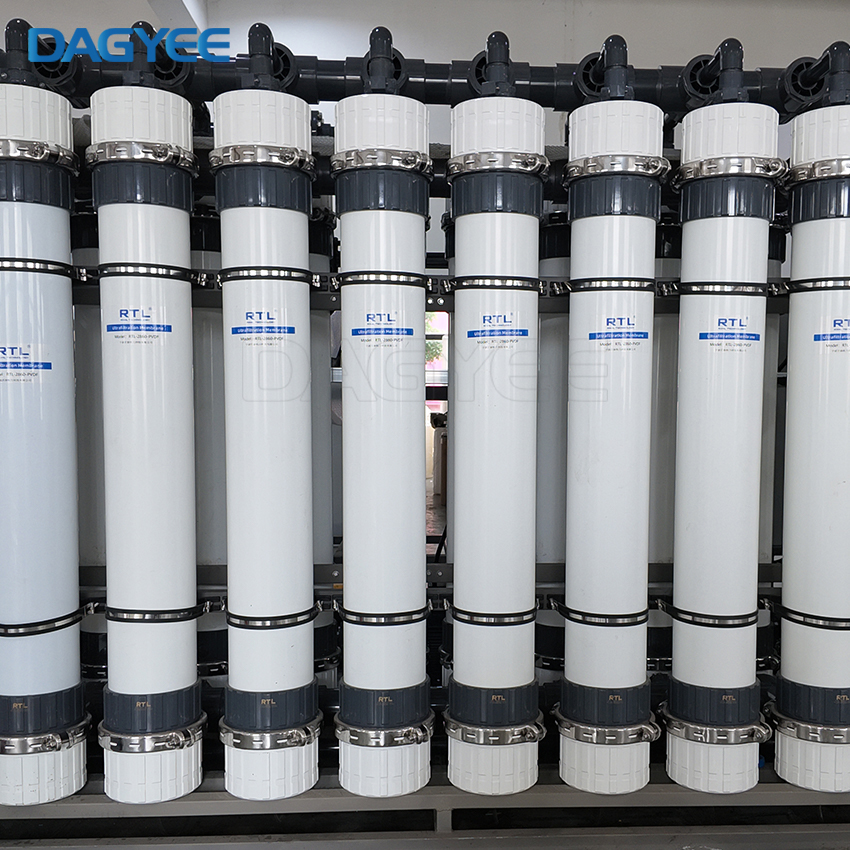
Pitfall 11: Force Overload Flux for Production Output
Facing tight factory water supply demand, on-site operators often manually lift operating flux beyond design limits. This temporary output boost brings devastating long-term losses. Once the running flux exceeds rated value by 15%, membrane surface shear force fails to strip sticky colloids, and reversible surface pollution rapidly turns into irreversible internal pore blockage.
The most intuitive consequence is shortened CIP cleaning cycle: from monthly routine maintenance to weekly forced cleaning. Chemical consumption rises by nearly 120%, and membrane aging speed accelerates doubly. The safest operation discipline is locking flux parameters via PLC background to forbid manual overloading modification.
Pitfall 12: Distorted Backwash & Air Scrubbing Cycle Setting
Two opposite operational errors widely exist in on-site maintenance: extending backwash intervals to save water consumption, or shortening air scrubbing time to cut blower power cost. For conventional surface water treatment, the standard running cycle is 30 to 60 minutes backwash with 40 seconds air scrubbing.
For brewery, slaughterhouse and oily wastewater scenarios, pollutants have strong adhesion. Operators need to shorten backwash intervals to 15 minutes and extend air scrubbing duration to 60 seconds. Ignoring working condition differentiation is the main trigger of seasonal UF system breakdown.
Pitfall 13: Misuse Cleaning Chemicals for Fouling Removal
Chemical cleaning misoperation ranks top 3 of ultrafiltration operational faults. On-site maintenance staff without professional training commonly uses citric acid to dissolve organic biofilm, or adopts sodium hypochlorite to eliminate calcium scaling. Wrong agent selection cannot remove pollutants, and will trigger membrane polymer degradation.
We summarize universal differentiated CIP cleaning SOP for global engineers: implement alkali and sodium hypochlorite combined circulation to eliminate organic fouling and biological slime; adopt 2% to 3% citric acid low-temperature circulation to dissolve inorganic hardness scaling. Never mix oxidant and acid detergent to avoid chemical reaction corrosion.
Pitfall 14: Abandon Real-Time Online KPI Monitoring
Many cost-saving ultrafiltration configurations cancel pressure transmitters, flow meters and differential pressure alarms, relying entirely on manual periodic detection. Discontinuous monitoring misses early fouling warning signals, including slow TMP rise and normalized flux attenuation.
Qualified automated UF systems shall record four core indicators 24/7: inlet pressure, permeate side pressure, real-time flux and water temperature. Setting threshold automatic alarms can cut 68% of sudden system shutdown risks, which is low-cost but high-return optimization.
Pitfall 15: Omit Membrane Integrity Test & Seasonal Adaptation Adjustment
Most water treatment teams only repair ultrafiltration equipment after water quality deterioration, lacking regular membrane integrity detection. Tiny filament cracks cannot be found via daily visual inspection, letting raw water penetrate into produced water and pollute finished water tanks for months.
Besides, winter low temperature is easily overlooked. When inlet water temperature drops below 15℃, water viscosity rises and membrane permeability declines. Without heat exchange compensation, water output drops sharply, triggering unnecessary overload operation and membrane damage.
Chapter 4: Final Pre-Launch Avoidance Checklist for New UF Projects
1.Complete full-component raw water laboratory detection before membrane material and MWCO confirmation
2.Carry out 72-hour uninterrupted on-site pilot test with actual factory inlet water
3.Calculate 5-year full-cycle TCO instead of comparing one-time equipment quotation
4.Reserve 20%~30% water processing capacity redundancy for peak load and seasonal water quality fluctuation
5.Mandatory dual-stage pretreatment: 1mm coarse filtration + 400μm precision cartridge filtration
6.Configure mutually independent acid and alkali CIP cleaning pipelines with automatic dosing modules
7.Cap maximum system water recovery rate under 80%, downgrade to 70% for high-oily wastewater
8.Adopt balanced manifold hydraulic layout to avoid dead-zone pollutant accumulation
9.Install 24-hour online monitoring sensors with abnormal pressure automatic alarm
10.Customize backwash and air scrubbing cycle based on actual pollutant characteristics
11.Formulate classified chemical cleaning SOP for organic and inorganic fouling separately
12.Schedule monthly bubble-point membrane integrity inspection and quarterly equipment calibration
Conclusion
After sorting out academic research and hundreds of global ultrafiltration project cases, we can confirm that over 89% of UF system failures are preventable. Ultrafiltration water treatment is never a simple equipment procurement business, but a systematic engineering project covering raw water detection, material matching, hydraulic design and standardized operation.
Blindly pursuing low supplier quotation and exaggerated water yield parameters will inevitably bring long-term operational losses. Matching membrane materials with on-site water quality, completing necessary pilot verification, optimizing front-end pretreatment structure, and implementing refined daily maintenance can extend PVDF ultrafiltration service life to 5 to 7 years. Meanwhile, standardized configuration cuts comprehensive water treatment cost by 41%, stabilizes outlet water compliance, and helps overseas factories avoid environmental governance penalties.
As global industrial water discharge regulations become stricter, reliable low-failure ultrafiltration systems will turn from auxiliary production equipment into core environmental assets. Bypassing these 15 common pitfalls can help water treatment contractors and end-user factories build cost-effective, low-maintenance and high-stability water purification infrastructure, and obtain sustainable long-term investment returns.
Name: Ashely Li
Mobile:+8613961861780
Tel:+8613961861780
Whatsapp:8613961861780
Email:info@dagyee.com
Add:Room 302, Building 11-4, Hongyi Road, Xinan Town, Xinwu District, jiangsu Province, China