English
 Chinese
info@dagyee.com
+8613961861780

I. Working Principle of Lamella Clarifier
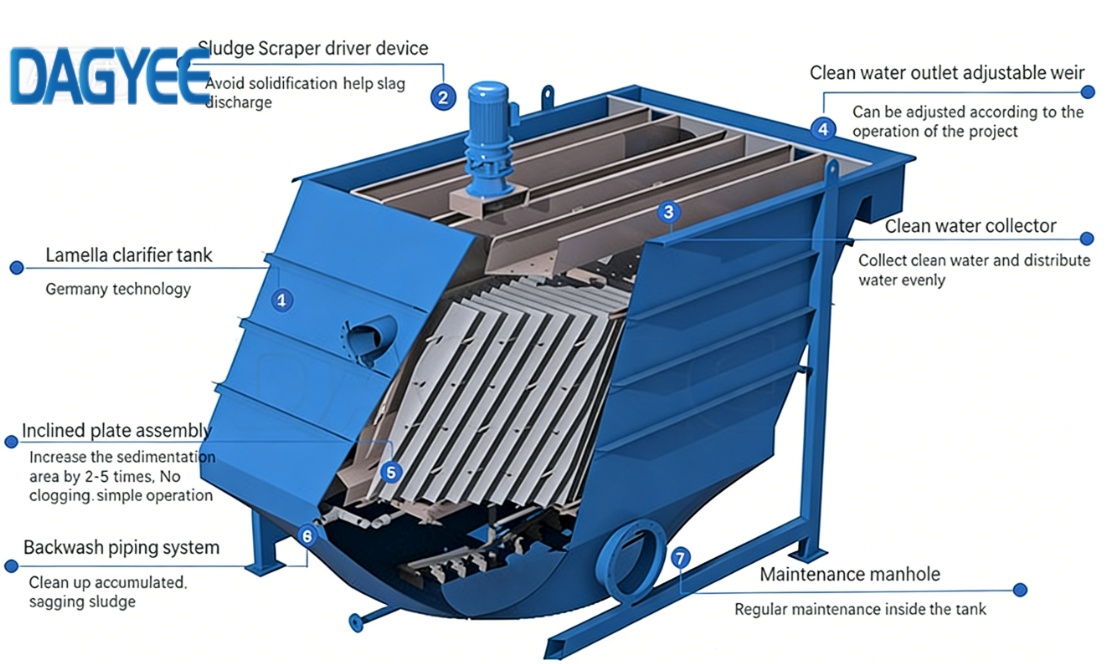
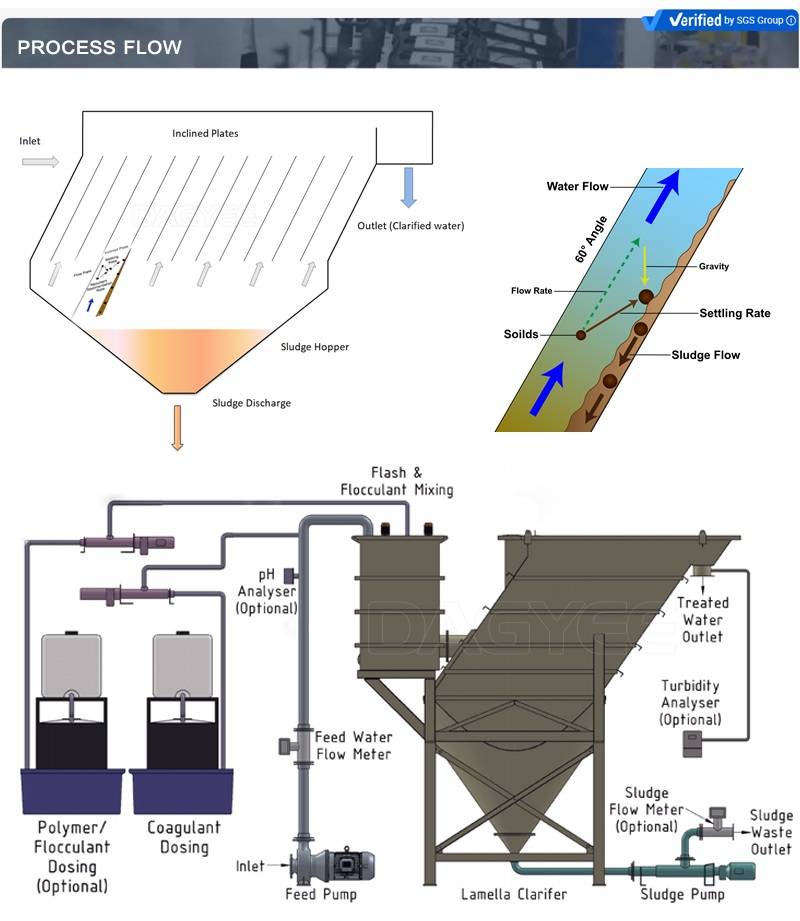
The core design basis of the Lamella Clarifier is the shallow pool sedimentation theory, which is an important theoretical foundation for the optimization and upgrading of sedimentation processes. Its core logic is as follows: Under the condition that the effective volume of the sedimentation tank remains constant, the effective sedimentation area of the sedimentation tank is positively correlated with the sedimentation efficiency. The larger the effective sedimentation area, the more suspended particles that can be settled within a unit of time, and the better the overall solid-liquid separation effect. Moreover, there is no direct correlation between the sedimentation efficiency and the residence time of the water body in the tank; at the same time, the shallower the effective sedimentation depth of the tank, the shorter the distance that suspended particles travel from the water body to the bottom of the tank, and the time required for the sedimentation process will be significantly shortened.
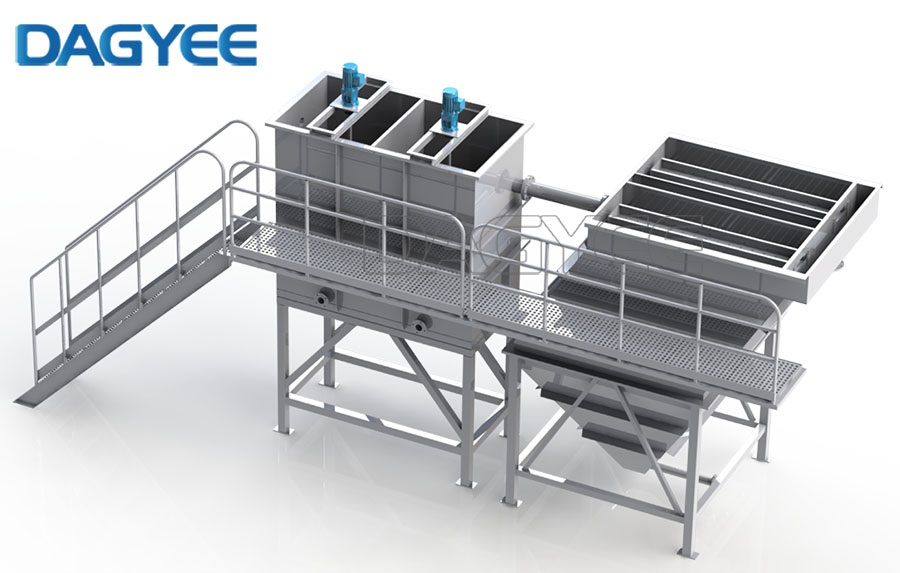
The lamella clarifier fully implements the shallow tank principle in its structural design. By arranging a series of inclined plates in a regular pattern inside the tank, the originally continuous water flow is divided into multiple thin and stable water layers. This structural design overcomes the drawbacks of traditional sedimentation tanks, such as chaotic water flow and long sedimentation paths, enabling each layer of water to form an independent sedimentation area. This not only increases the effective sedimentation area but also enables suspended particles to rapidly settle within a short distance, ultimately achieving efficient and stable solid-liquid separation. It is a widely used efficient sedimentation process in the current water treatment industry.
II. Characteristics of the Lamella Clarifier
1. Stable hydraulic flow pattern, superior laminar flow conditions
The lamella clarifier fully utilizes the laminar flow principle to optimize the water flow state. When water flows through the gaps between the inclined plates, the cross-sectional area of the water passage is narrow, and the hydraulic radius is much smaller than that of traditional horizontal flow sedimentation tanks. The smaller hydraulic radius significantly reduces the Reynolds number of the water flow. Under normal operation, the Reynolds number Re is stable at around 200, and the water flow maintains a stable laminar state throughout the process, with no obvious turbulent disturbance. This provides an ideal environment for the uniform sedimentation of suspended particles. At the same time, the Froude number of the water flow between the inclined plates remains between 1×10⁻³ and 1×10⁻⁴, ensuring extremely strong water flow stability. It will not cause the already settled particles to rise due to flow velocity fluctuations or water body disturbances, significantly improving the sedimentation reliability.
2. Effective settling area expands significantly, and the settling efficiency is greatly enhanced
The dense arrangement of inclined plates enables a geometrically exponential increase in the effective settling area without increasing the footprint or volume of the tank. This directly surpasses the upper limit of the traditional settling tank's settling efficiency. Influenced by multiple factors such as the installation angle of the inclined plates, the density of the filler arrangement, the uniformity of water distribution in the inlet and outlet, and the actual flow pattern within the gaps between the plates, the actual treatment capacity of the inclined plate settling tank cannot fully reach the theoretical calculation multiple. In the industry, the ratio of the actual settling efficiency to the theoretical settling efficiency is defined as the effective coefficient, which is also an important indicator for evaluating the rationality of the design and operation effect of the inclined plate settling tank. Even with efficiency losses, its settling efficiency is still much higher than that of the traditional surface flow settling tank.
3. The settling distance of particles is shortened, and the residence time is significantly reduced
In traditional sedimentation tanks, suspended particles need to settle from the water surface to the bottom of the tank. The settling distance is long and the time is long. However, in the lamella clarifier, through the design of stratified water flow, the settling distance of suspended particles is compressed to within the spacing of the inclined plates. The particles only need to settle a short distance before attaching to the inclined plates and then sliding down along the slope of the inclined plates to the sludge area at the bottom of the tank. The significant reduction in the settling distance directly reduces the hydraulic residence time of the water in the sedimentation tank. This not only increases the water treatment capacity per unit time but also lowers the construction cost of the tank, making it suitable for all new and renovated water treatment projects.
4. Secondary coagulation of flocs, enhancing the sedimentation effect
After the raw water undergoes the coagulation process, the formed floc particles enter the inclined plate packing area. In the narrow water flow channel, they will frequently collide and contact with each other. The flocs will adsorb and aggregate with each other, achieving secondary coagulation. The originally smaller and with poorer sedimentation performance fine flocs will grow into dense and heavy large flocs through secondary coagulation, significantly increasing the sedimentation speed. This further improves the overall sedimentation efficiency of the sedimentation tank and can effectively reduce the turbidity of the effluent, ensuring the stable operation of the subsequent water treatment processes.
III. Key Design Points for Lamella Clarifier
| Parameter | Typical Value | Significance |
| Reynolds Number (\(Re\)) | ≈ 200 | Maintains stable laminar flow, avoids turbulence |
| Froude Number (\(Fr\)) | \( 1 \times 10^{-3} \sim 1 \times 10^{-4} \) | Ensures high flow stability, prevents resuspension |
| Effective Coefficient | 0.6 ~ 0.85 | Ratio of actual to theoretical settling efficiency |
| Hydraulic Radius | Smaller than conventional sedimentation tanks | Improves laminar flow condition |
(I) Key Design Points for Counter-flow Lamella Clarifier
The flow direction of counter-flow lamella clarifier is opposite to the particle sedimentation direction. It is the most widely used type in water treatment engineering. The design parameters need to be precisely controlled based on the original water quality:
1. Applicable water quality: The original water turbidity should be consistently lower than 1000 NTU. If the operation is carried out with long-term excessive turbidity, it will easily cause blockage of the inclined plates and sludge accumulation, affecting the operation effect;
2. Liquid surface load: The liquid surface load in the inclined plate sedimentation area should be controlled within 9.0 - 11.0 m³/(h·m²). If the load is too high, the water flow speed will be too fast, and the particles will not have time to sediment; if the load is too low, it will result in waste of the pool resources;
3. Structural parameters: The spacing of the inclined plates should be reasonably selected based on the treated water quality. The plate length is uniformly designed as 1m, taking into account both the sedimentation effect and the ease of installation;
4. Installation angle: The inclined plates are installed at a 60° inclination angle with respect to the horizontal plane. This angle can ensure smooth water flow passage and allow the settled sludge to smoothly slide to the bottom of the tank, avoiding the sludge adhering to the inclined plates;
5. Protection of the clear water zone: The protection height of the clear water zone above the inclined plates should not be less than 1.5m. This prevents the water flow fluctuation from carrying the settled sludge above the inclined plates out, ensuring the stability of the effluent quality.
(2) Design Key Points of Parallel Flow Sloping Lamella Clarifier
The flow direction of the parallel flow sloping lamella clarifier is consistent with the particle sedimentation direction, which is suitable for specific low turbidity water treatment scenarios. The design should follow the following requirements:
1. Applicable water quality: It is only applicable to scenarios where the original water turbidity is consistently lower than 200 NTU. High turbidity water can cause sludge accumulation and make normal sludge discharge impossible;
2. Liquid surface load: It needs to be determined based on the original water quality characteristics, local climate conditions, and the operation experience or test data of similar water plants. The conventional range is 30 to 40 m³/(h·m²);
3. Structural parameters: The spacing of the sloping plates is set at 35 mm to ensure smooth water flow and not affect particle sedimentation; the length of the sloping plates is 2.0 to 2.5 m, and the length of the sludge discharge area sloping plates is not less than 0.5 m to ensure that sludge can be smoothly collected to the sludge hopper;
4. Inclination design: The inclination angle of the sedimentation area sloping plates is 40°, which is suitable for the parallel flow state; the inclination angle of the sludge discharge area sloping plates is increased to 60°, using gravity to accelerate sludge sliding and preventing sludge accumulation in the sludge discharge area.
| Item | Counter-flow Type | Parallel-flow Type |
| Inlet Water Turbidity Limit | < 1000 NTU | < 200 NTU |
| Surface Loading Rate | 9.0 – 11.0 m³/(h·m²) | 30 – 40 m³/(h·m²) |
| Inclined Plate Length | 1.0 m | 2.0 – 2.5 m |
| Plate Spacing | Determined by water quality | 35 mm |
| Inclination Angle (Sedimentation Zone) | 60° | 40° |
| Inclination Angle (Sludge Discharge Zone) | 60° | 60° |
| Clear Water Zone Protection Height | ≥ 1.5 m | Determined by project scale |
IV. Influencing Factors on the Sedimentation Effect of lamella clarifier
The operation effect of lamella clarifier is influenced by multiple factors such as water flow distribution, pre-treatment processes, and water quality characteristics. The key influencing factors are as follows:
1. Uneven distribution of water flow and significant disturbance at the inlet and outlet
The central area of the inclined plate experiences stable water flow, maintaining an ideal laminar flow state, which results in the best sedimentation effect. However, the inlet section is affected by the impact of incoming water flow and sudden changes in flow velocity, while the outlet section is influenced by the collection of water by the outlet weir and fluctuations in water level. Both sections have obvious water flow disturbances, which can easily cause local turbulence. Turbulence can disrupt the stability of the flocs, preventing fine suspended particles from settling normally, thereby directly affecting the overall sedimentation efficiency.
2. The stability of water flow is the core guarantee for the sedimentation effect
The stability of water flow between the inclined plates directly determines the sedimentation effect. When the water flow velocity is uniform and without significant fluctuations, the suspended particles can settle at a constant speed, and the flocs are less likely to break; if the influent flow fluctuates too much and the water distribution is uneven, it will cause sudden increases and decreases in local flow velocity, breaking the stable water flow state. This not only affects the particle settling but also will lift the sludge deposited at the bottom of the tank, resulting in an increase in the turbidity of the effluent.
3. The pre-flocculation effect determines the upper limit of the sedimentation process
The lamella clarifier has a short settling distance and a short retention time, which requires extremely high requirements for the pre-flocculation process. The raw water needs to be fully flocculated before entering the sedimentation tank to form flocs with large particle size, high density and fast settling speed; if the flocculation is insufficient, the flocs will be small and loose, and cannot complete the settling within a short period of time in the inclined plate, thus flowing out of the sedimentation tank with the water flow, resulting in non-compliant effluent quality.
4. The Adaptability of Turbid Water Inhomogeneous Flow to Water Flow Direction Affects Treatment Effect
Turbid water inhomogeneous flow is an important hydraulic factor affecting the sedimentation effect. It has the least interference on upward-flow lamella clarifier, so the upward-flow structure is more suitable for treating high turbidity raw water; downward-flow lamella clarifier are more affected by inhomogeneous flow and are only suitable for treating extremely low turbidity raw water. If the water flow direction does not match the turbidity characteristics of the raw water, it will aggravate the water flow disorder and reduce the sedimentation efficiency.
V. Common Problems and Solutions for Lamella Clarifier
Excessive Turbidity in Effluent
Excessive turbidity in the effluent is the most common operational problem for lamella clarifier, which directly leads to an increase in the load of the subsequent filtration process and even affects the final effluent quality. The causes and solutions are as follows:
Cause Analysis
1. Uneven Water Distribution and Local Turbulence Causing Sludge Erosion
If the water distribution system in the inlet of the lamella clarifier is improperly designed, uneven water distribution will occur. Near the inlet, the water flow velocity is too fast, resulting in severe turbulence. The high-speed water flow not only interferes with the sedimentation of suspended particles but also causes the sludge already deposited on the inclined plate and the accumulated sludge at the bottom of the tank to resurface, allowing the sludge to enter the clear water zone along with the water flow, leading to an increase in the turbidity of the effluent.
2. Short flow phenomenon in the tank, failure of floc disintegration
When short flow occurs in the tank, some of the raw water does not undergo sufficient sedimentation before rapidly flowing to the outlet weir, shortening the effective sedimentation time. At the same time, the water shear force brought by the short flow will destroy the floc formed through flocculation in the early stage, causing large flocs to break into fine suspended particles. These particles cannot settle within the inclined plate and will eventually be discharged with the effluent, resulting in excessive turbidity.
3. Excessive flow rate of water distribution holes leads to secondary fragmentation of flocs
To achieve uniform water distribution, the perforated wall of the lamella clarifier has a relatively small opening range and a limited number of openings. This results in the flow rate passing through the holes being much higher than that of traditional horizontal flow sedimentation tanks. The high-speed water flow directly breaks the flocs that have formed earlier, and also disturbs the settled dead mud at the bottom of the distribution holes. The rising dead mud then enters the sedimentation area with the water flow, further increasing the turbidity of the effluent.
Solution
1. Optimize the inclined plate structure and add wing plates to enhance the flow pattern
The inclined plates are still installed at a 60° angle to the horizontal plane. Below each inclined plate, an equal number of wing plates are evenly added, which also have a 60° inclination angle to the horizontal plane. The newly added wing plates can further reduce the flow passage area, significantly lower the Reynolds number of the water flow, enhance the viscosity of the water flow, making the flow more stable; at the same time, they shorten the path for particle sedimentation, facilitating the rapid sedimentation of particles with higher density and reducing the probability of sludge scumming.
2. Optimize the water distribution system and strictly control the flow rate
Employ perforated wall for uniform water distribution. Reasonably expand the opening range and increase the number of openings to reduce the flow velocity through the openings. Strictly control the horizontal flow velocity at the starting point of the water distribution area within 0.010 to 0.018 m/s to avoid high-speed water flow impact. At the same time, add a flow stabilizing grille at the water inlet to further disperse the water flow and eliminate the turbulence at the inlet, achieving uniform water distribution.
3. Add a laminar rectification section and optimize the flow diversion structure
At the front end of the lamella clarifier, add a laminar rectification section, which accounts for 1/3 of the total length of the tank. The raw water first enters the laminar rectification section for preliminary rectification and slow sedimentation, reducing the flow velocity before entering the inclined plate sedimentation area. This significantly enhances the tank's ability to withstand shock loads and reduces the upward flow velocity in the inclined plate section. Additionally, a flow diversion partition is installed between the laminar rectification section and the inclined plate section to guide the water flow evenly into the inclined plate area, avoiding excessive local flow velocities, thereby further improving the sedimentation efficiency.
| Position | Recommended Velocity | Control Objective |
| Water Distribution Zone Initial Flow Velocity | 0.010 – 0.018 m/s | Avoid floc breakage & sludge resuspension |
| Flow Velocity Through Perforated Holes | Lower than conventional tanks | Reduce turbulence |
| Upward Flow Velocity in Plate Section | Moderate, reduced by rectifier | Improve settling stability |
VI. Contact Us for Customized Lamella Clarifier Solutions
If you are interested in learning more about our lamella clarifier or need a customized solution for your water treatment project, please contact our sales team. Our experts will work with you to assess your requirements and recommend the perfect equipment to meet your goals.

Name: Ashely Li
Mobile:+8613961861780
Tel:+8613961861780
Whatsapp:8613961861780
Email:info@dagyee.com
Add:Room 302, Building 11-4, Hongyi Road, Xinan Town, Xinwu District, jiangsu Province, China