English
 Chinese
info@dagyee.com
+8613961861780

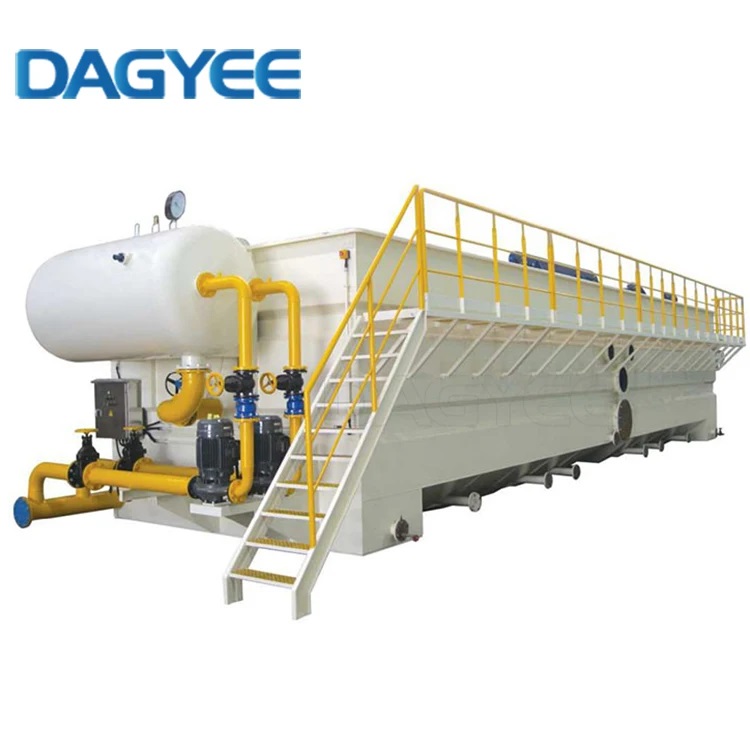
This article will combine real engineering cases, measured data, clear technical comparisons, and practical parameter guidance to comprehensively analyze the core logic and applicable scenarios of dissolved air flotation technology, focusing on the actual treatment effects of DAF dissolved dissolved air flotation in oily wastewater and municipal sewage. It will also share the key factors affecting the operation efficiency of the dissolved air flotation system and optimization techniques, helping you fully understand: why dissolved air flotation can become the core solution for wastewater treatment, and how to make the dissolved air flotation system operate stably, reduce energy consumption, and save costs, helping enterprises meet environmental protection standards and achieve efficient production.
I. What is dissolved air flotation technology? The core principle can be explained in one sentence, and even beginners can understand it.
Many people's understanding of dissolved air flotation technology stops at "using bubbles to treat wastewater", but its core logic is to achieve efficient separation of pollutants from water through a combination of physical and chemical methods. Essentially, it is "using tiny bubbles to 'grab' pollutants in the water and then quickly float them to the surface to achieve centralized removal". Compared with the traditional sedimentation process that "lets pollutants sink by gravity", dissolved air flotation technology specifically addresses the pain points of "light density, fine particles, and difficult to settle" pollution, and has a wider application range and higher treatment efficiency.
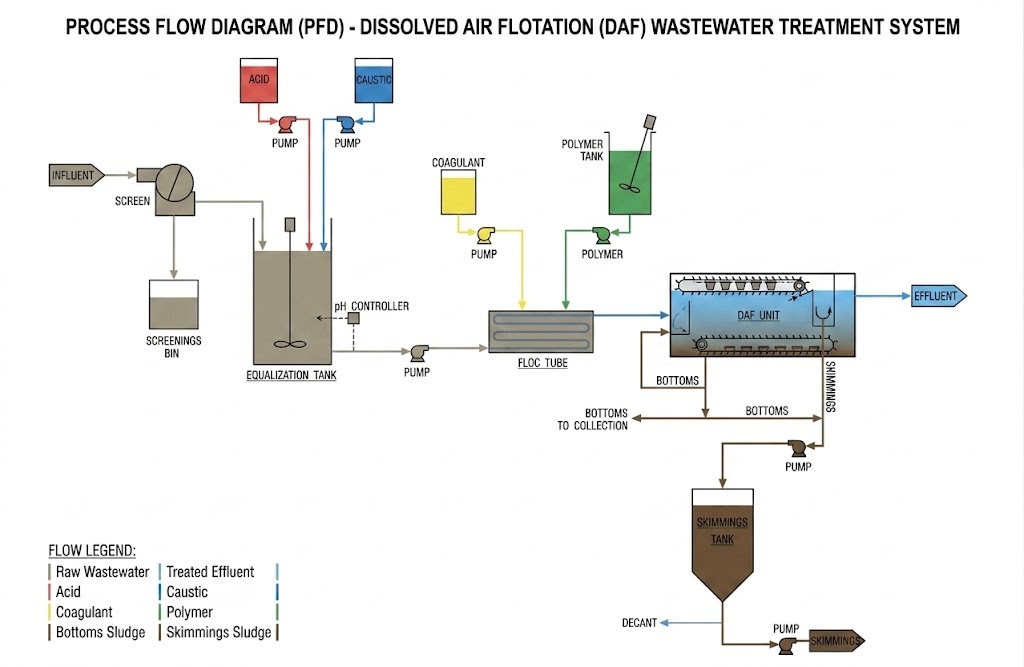
Specifically, the complete working logic of dissolved air flotation technology consists of 4 key steps, each of which directly affects the final treatment effect and is indispensable:
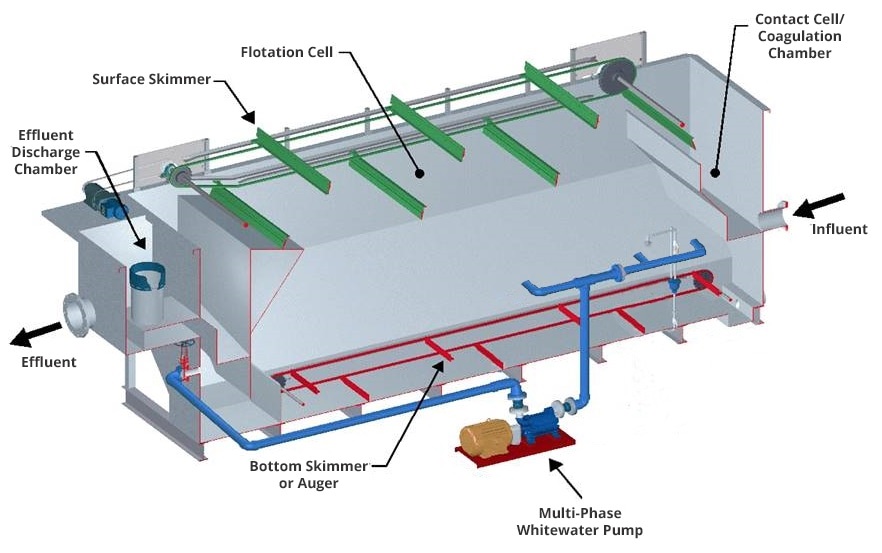
1. Micro-bubble generation: Through specific equipment to generate a large number of uniform and fine micro-bubbles in the wastewater. The particle size and uniformity of the bubbles directly determine the efficiency of pollutant adsorption. The smaller the particle size and the more uniform the distribution, the better the adsorption effect, and the faster the subsequent flotation speed.
2. Bubble and pollutants combination: Micro-bubbles combine with oils (especially emulsified oils), colloidal particles, suspended solids, and emulsified pollutants to form stable "bubble—pollutant complexes". During this process, it can be combined with the addition of demulsifiers, coagulants, and coagulant aids to enhance the stability of the complex, making pollutants easier to be "grabbed" by the bubbles.\
3. Complexes flotation: Due to the lower density of "bubble—pollutant complexes" compared to water, they will float rapidly upward and eventually accumulate on the water surface, forming a layer of scum. This flotation process is several times faster than the sinking process of traditional sedimentation, significantly reducing the retention time of wastewater treatment.
4. Scum removal: Through equipment such as scraper machines, the scum layer on the water surface is uniformly scraped off and collected, achieving efficient solid-liquid separation. Finally, the treated water that meets discharge standards is obtained, and the scraped-off scum can be further dehydrated and disposed of to achieve pollutant reduction.
Here, we will focus on comparing the core differences between traditional sedimentation processes and dissolved air flotation technology to help you quickly determine which process is more suitable for your scenario:
1. Traditional sedimentation process: Only effective for pollutants with a density greater than water and larger particles (such as sediment and large-sized suspended solids). For pollutants with a density close to water, fine particles (particle size < 10μm) and stable emulsions (such as emulsified oil and colloids), the removal effect is extremely poor, and even cannot be removed; and the treatment speed is slow, with the hydraulic retention time usually requiring more than 30 minutes, large in area, and significantly affected by water temperature. The removal efficiency will drop significantly in low-temperature environments.
2. Dissolved air flotation technology: Specifically designed to solve the problems of pollutants with a density close to water, fine particles, stable emulsions, and difficult to settle. The treatment speed is fast, the hydraulic retention time can be shortened to 10-20 minutes (shallow dissolved air flotation even only requires 3-5 minutes); the area is only 1/3-1/5 of the traditional sedimentation tank, suitable for the renovation of old plants and scenarios with limited land; it has stronger adaptability to low-temperature and low-turbidity water, and can maintain stable treatment effects even in winter when water temperature is low.
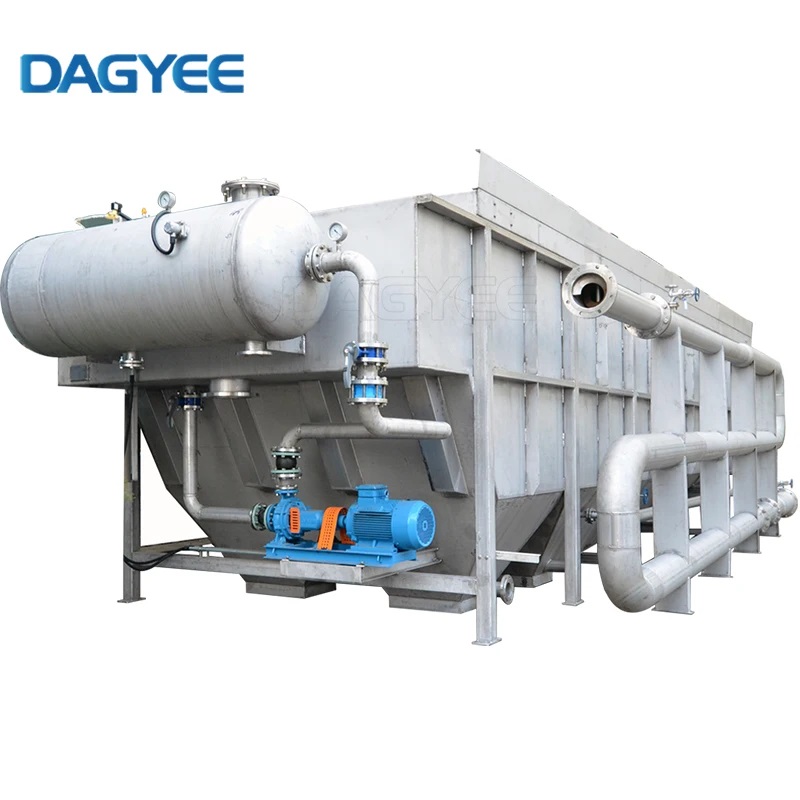
Among all the dissolved air flotation technology routes, dissolved dissolved air flotation (DAF) is currently the most widely used, stable in operation, and has the highest removal rate in the industrial and municipal fields. It is also the core technology that this article focuses on explaining. Compared with other types of dissolved air flotation, DAF generates micro-bubbles through pressurized dissolution and depressurized release, with more uniform bubble particle size (10-100μm) and higher adsorption efficiency, resulting in more stable treatment effects and the ability to adapt to various complex water qualities. It is the preferred choice for most enterprises to achieve environmental protection compliance and upgrade their facilities.
II. Comparison of the two main types of dissolved air flotation technologies: Why is DAF the preferred choice? Avoiding selection pitfalls
The commonly used dissolved air flotation technologies in the current wastewater treatment field are mainly divided into three types: dissolved dissolved air flotation (DAF), electrolytic dissolved air flotation (EAF), and dispersed dissolved air flotation (CAF). These three technologies have significant differences in bubble generation methods, applicable scenarios, treatment efficiency, and operating costs. Many enterprises tend to make mistakes when selecting, either choosing a technology that is not suitable for their own water quality or resulting in substandard treatment effects and high operation and maintenance costs. The following detailed table clearly compares the core parameters and applicable scenarios of the three, helping you quickly select and avoid detours.
| Flotation Technology | Abbreviation | Bubble Generation Method | Bubble Size (μm) | Typical Applicable Wastewater | Core Advantages | Core Disadvantages | Pollutant Removal Efficiency | Operating Cost (CNY/ton water) |
| Dissolved Air Flotation | DAF | Pressurized dissolution → Decompression release micro-bubbles, can be enhanced with coagulants | 10 - 100 | Municipal wastewater, petrochemical oily wastewater, food processing, slaughterhouse, textile printing, papermaking | Stable operation, high removal efficiency, strong adaptability, less affected by water quality fluctuations, flexible adjustment | Relatively complex equipment structure, high initial investment | 85% - 95% (oily wastewater up to 92%+) | 1.2 - 2.5 |
| Electrolytic Flotation | EAF | Electrode electrolysis produces hydrogen and oxygen micro-bubbles, simultaneous redox reactions | 5 - 50 | Electroplating wastewater, heavy metal wastewater, high-concentration organic wastewater, chlorine-containing wastewater | Simultaneous removal of heavy metals and organics, strong oxidation degradation, no additional air dissolution equipment needed | High energy consumption, easily worn electrodes, high maintenance cost, not suitable for high-salinity wastewater | 90%+ (heavy metal removal up to 95%+) | 3.5 - 6.0 |
| Cavitation Air Flotation | CAF | Compressed air through diffuser, impeller shear generates bubbles | 100 - 1000 | High SS wastewater, papermaking wastewater pretreatment, leather wastewater pretreatment, low-concentration oily wastewater | Simple equipment, low initial investment, easy installation, low maintenance difficulty | Large bubble size, low adsorption efficiency, unstable treatment performance, prone to secondary pollution | Pretreatment level, removal rate 60% - 75% (only suitable for front-end rough treatment) | 0.8 - 1.5 |
From the table data, it can be intuitively seen that DAF dissolved dissolved air flotation is comprehensively superior in terms of versatility, stability, and removal rate. Especially when dealing with complex water qualities such as oily wastewater and municipal sewage, its advantages are more pronounced. Although the initial investment is slightly higher than that of air dispersion flotation, in the long run, its stable treatment effect and lower operation and maintenance costs can help enterprises avoid fines and production suspension risks due to non-compliance with environmental protection standards. The overall cost performance is the highest. While electrolytic dissolved air flotation is only suitable for specific heavy metal wastewater scenarios, and air dispersion flotation is only suitable for the initial coarse treatment, it cannot meet the high-standard discharge requirements. Therefore, for the vast majority of industrial enterprises and municipal wastewater treatment plants, DAF dissolved dissolved air flotation is the optimal choice.
III. DAF Dissolved dissolved air flotation: The "Demulsifier King" for Petrochemical Oily Wastewater, Verified by Actual Data
Traditional sedimentation and filtration processes are almost unable to remove it, and even lead to the "worse treatment, worse turbidity" phenomenon. If the oily wastewater directly enters the downstream biochemical system, it will cause a series of serious problems: sludge expansion in the biochemical tank, microbial poisoning and death, resulting in long-term exceedance of COD and oil content; pipe and equipment scaling and blockage, increasing maintenance costs; ultimately unable to meet the environmental protection discharge standards, facing the risk of production suspension and fines.
However, DAF dissolved dissolved air flotation, with its strong adsorption capacity of tiny bubbles, combined with reasonable demulsification and coagulation processes, can efficiently break the stable structure of emulsified oil and achieve the complete separation of oil and water, becoming the "demulsifier king" for petrochemical oily wastewater treatment. Below, through two real engineering cases of petrochemical enterprises, the actual data is used to visually display the treatment effect of DAF, for reference by relevant enterprises.
Case 1: A large petrochemical enterprise oily wastewater treatment project (high emulsified oil content)
This enterprise mainly produces refined oil and chemical raw materials. The oily wastewater produced during the production process has an original water content of 150 mg/L, with emulsified oil accounting for more than 60% of it, along with a small amount of suspended solids and COD (original water COD ≈ 800 mg/L). The traditional oil separation + sedimentation process could not reduce the oil content in the effluent to 15 mg/L or below, which is the requirement for the downstream biochemical system (the biochemical system requires an oil content of ≤ 15 mg/L). The pressure for environmental protection compliance is extremely high.
In response to the water quality characteristics of this enterprise, a treatment plan of "demulsification + coagulation pre-treatment + DAF dissolved dissolved air flotation as the main process" was adopted. The specific process is as follows: oily wastewater → oil separator (removes floating oil) → demulsification reaction tank (add demulsifier) → coagulation reaction tank (add PAC, PAM) → DAF dissolved dissolved air flotation tank → biochemical system.
After 3 months of stable operation, the actual treatment effect is as follows:
1. Oil content: original water 150 mg/L → effluent 12 mg/L or below, removal rate ≥ 92%, fully meeting the requirements of the downstream biochemical system;
2. COD: original water 800 mg/L → effluent 520 mg/L, removal rate 35%, significantly reducing the load of the downstream biochemical system;
3. SS: original water 120 mg/L → effluent 28 mg/L, removal rate 77%, reducing the risk of subsequent pipeline blockage;
4. Operation stability: continuous operation for 3 months, no equipment failure, stable effluent indicators, even if the original water oil content experiences a brief fluctuation (up to 200 mg/L), the effluent can still be stably compliant.
Case 2: An oilfield produced water treatment project (high-salt oily wastewater)
The produced water from oil fields is a kind of highly saline and oily wastewater. The original water contains 80-120 mg/L of oil and more than 30,000 mg/L of salt. The emulsified oil particles are very fine. Traditional treatment methods are extremely difficult to handle it. This project adopts a combined process of "DAF dissolved dissolved air flotation + ultrafiltration", focusing on solving the problems of emulsified oil and suspended matter removal.
Measured treatment effect: The removal rate of oil content is 93%, and the oil content in the effluent is ≤ 5 mg/L; The removal rate of SS is 90%, and the SS in the effluent is ≤ 10 mg/L; The treated wastewater can be recycled for oil field injection, achieving water resource recycling and utilization, and saving water resource costs for enterprises by nearly 1 million yuan per year.
The reason why DAF can efficiently demulsify and remove oil is mainly due to three key points: First, the micro air bubble particle size is small (10-100 μm) and the specific surface area is large, which can quickly adsorb the fine emulsified oil particles, and the affinity between the air bubble and the oil droplet is strong, making it difficult to detach; Second, it can be combined with demulsifiers to break the stable structure of emulsified oil, allowing the oil droplets to aggregate, and then through coagulants to form flocs, combining with the air bubble to quickly float to the surface; Third, it has stable removal effects on emulsified, dispersed, and floating oil, is suitable for different oil concentrations of wastewater, and is easy to start and stop, suitable for continuous production scenarios. For petrochemical, engine oil, cutting fluid, and food oil wastewater, DAF is almost a standard pre-treatment process, which can safeguard the downstream biochemical system.
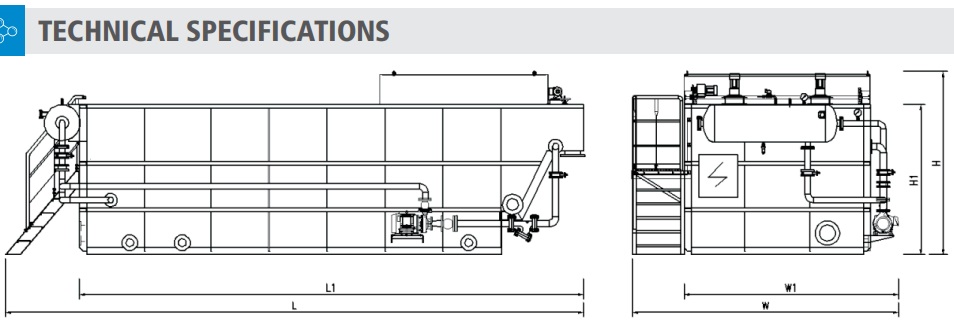
| DAF Model | Qmax (m³/h) | Piping Connections (DN) | Physical Dimensions (m) | ||||||||
| Inlet | Outlet | Sludge | Vent | L | L1 | W | W1 | H | H1 | ||
| DAF-002 | 2 | DN50 | DN50 | DN100 | DN100 | 3.4 | 2.5 | 3.4 | 1.2 | 2.2 | 1.7 |
| DAF-003 | 3 | DN50 | DN50 | DN100 | DN100 | 3.7 | 2.8 | 2.4 | 1.2 | 2.2 | 1.7 |
| DAF-005 | 5 | DN80 | DN80 | DN100 | DN100 | 4.0 | 3.0 | 2.4 | 1.2 | 2.2 | 1.7 |
| DAF-010 | 10 | DN100 | DN100 | DN100 | DN100 | 4.6 | 3.8 | 2.7 | 1.4 | 2.4 | 1.9 |
| DAF-015 | 15 | DN125 | DN100 | DN150 | DN100 | 5.6 | 4.5 | 2.9 | 1.7 | 2.5 | 2.0 |
| DAF-020 | 20 | DN150 | DN150 | DN150 | DN100 | 5.9 | 4.8 | 3.2 | 2.0 | 2.5 | 2.0 |
| DAF-030 | 30 | DN150 | DN150 | DN150 | DN100 | 6.8 | 5.5 | 3.2 | 2.2 | 2.7 | 2.2 |
| DAF-040 | 40 | DN200 | DN150 | DN150 | DN100 | 8.0 | 6.7 | 3.6 | 2.6 | 2.7 | 2.2 |
| DAF-050 | 50 | DN200 | DN150 | DN150 | DN100 | 8.4 | 7.0 | 3.6 | 2.6 | 2.7 | 2.2 |
| DAF-060 | 60 | DN250 | DN200 | DN150 | DN100 | 9.9 | 8.4 | 3.8 | 2.8 | 2.9 | 2.4 |
| DAF-070 | 70 | DN250 | DN200 | DN150 | DN100 | 10.5 | 9.0 | 3.8 | 2.8 | 2.9 | 2.4 |
| DAF-080 | 80 | DN250 | DN250 | DN150 | DN100 | 12.0 | 10.5 | 4.0 | 3.0 | 2.9 | 2.4 |
| DAF-100 | 100 | DN300 | DN250 | DN150 | DN100 | 12.0 | 10.5 | 4.2 | 3.2 | 2.9 | 2.4 |
| DAF-120 | 120 | DN300 | DN250 | DN150 | DN100 | 12.5 | 11.4 | 4.4 | 3.4 | 2.9 | 2.4 |
VI. Contact Us for More Information
If you are interested in learning more about our DAF system for your water treatment project, please contact our sales team.
Name: Ashely Li
Mobile:+8613961861780
Tel:+8613961861780
Whatsapp:8613961861780
Email:info@dagyee.com
Add:Room 302, Building 11-4, Hongyi Road, Xinan Town, Xinwu District, jiangsu Province, China