English
 Chinese
info@dagyee.com
+8613961861780

Sludge disposal remains one of the biggest ongoing cost burdens for municipal wastewater treatment plants, food processing factories, textile printing facilities and livestock farming operations across global markets. Traditional dewatering solutions including belt filter presses, plate-and-frame filter presses and centrifugal separators each carry obvious operational flaws: frequent filter cloth blockages, heavy power draw, complicated daily maintenance workflows or oversized footprint requirements that push up civil construction investment.
Over the past decade, screw sludge dewatering machines—especially stacked screw dewaterer variants—have rapidly replaced older dewatering hardware in small-to-medium decentralized sewage stations and large-scale industrial wastewater lines. Multiple full-scale field tests and academic experimental research published in open-access environmental engineering journals confirm that properly configured screw press dewatering units can cut polymer consumption by 12%–25%, reduce daily maintenance hours by over 70%, and deliver stable mud cake total solid (TS) content between 17% and 21% under continuous 24-hour running conditions.
Many plant procurement managers and wastewater engineering contractors struggle to source clear, data-backed reference materials to select matching screw sludge dewatering equipment. Most online content only provides superficial product introductions without real operational test data, parameter contrast tables or cross-equipment performance comparisons. This comprehensive guide consolidates experimental data from MDPI environmental research papers, ETH Zurich mechanical design dissertations and Deswater full municipal plant case studies. We break down core working principles, standard technical specifications, cross-category equipment cost & performance comparisons, real-site industrial application cases and practical parameter adjustment strategies to maximize dewatering output. Whether you run a containerized sewage treatment project, large municipal clarifier system or agricultural manure separation line, this article delivers actionable reference data to streamline your equipment selection process.
II.How Does a Screw Sludge Dewatering Machine Achieve Continuous Sludge Dewatering?
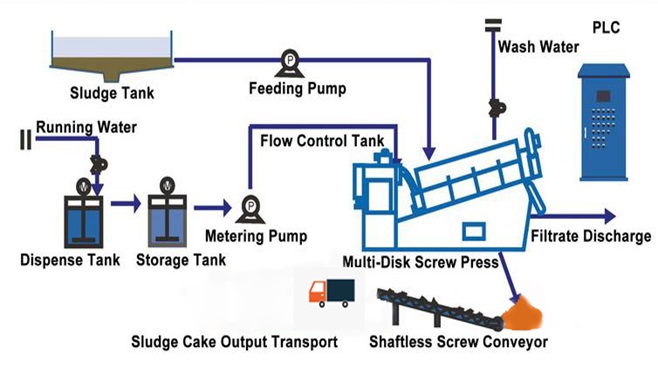
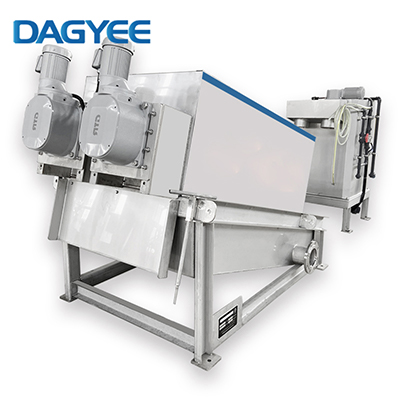
A standard stacked screw sludge dewatering machine relies on four core assemblies to complete solid-liquid separation without easily blocked filter media: variable-pitch screw shaft, dynamic and static stacked ring groups, adjustable backpressure baffle assembly and integrated polymer flocculation mixing tank. Unlike belt filter presses that rely on woven cloth filtration, stacked ring gaps replace traditional filter cloth, which eliminates fiber clogging caused by fine organic sludge particles such as activated sludge or food waste suspended solids.
The screw shaft features a gradually shrinking pitch design from sludge inlet zone to compression outlet zone. As flocculated sludge moves forward along the rotating screw, the available internal volume keeps shrinking, creating gradual extrusion pressure to squeeze free water out of sludge flocs. Thin filtrate flows through tiny gaps between overlapping static and moving stacked rings, while solid sludge aggregates are retained and pushed toward the mud cake discharge port. The backpressure plate installed at the outlet controls internal compression resistance; adjusting its tightness directly changes final mud cake dryness, a key tuning parameter covered later in this guide.
(1)Step-by-Step Dewatering Working Flow
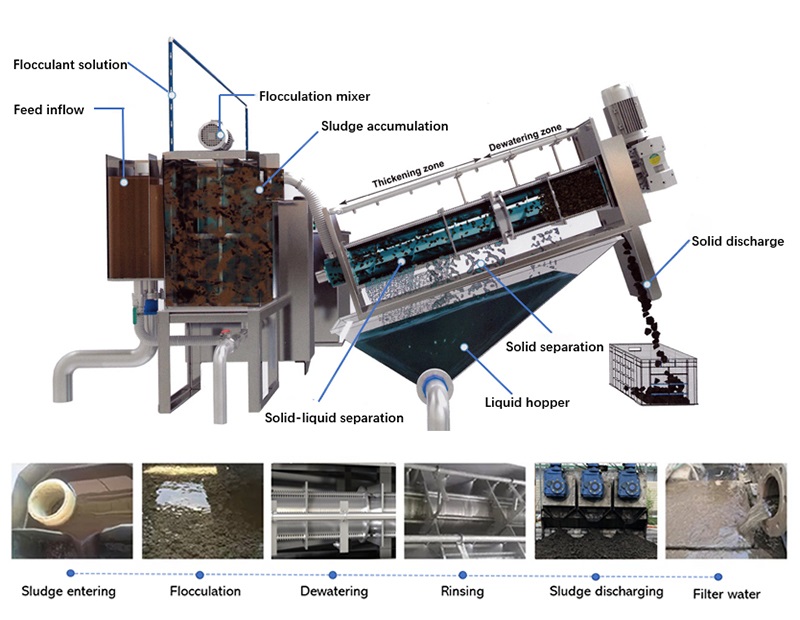
1. Flocculation mixing stage: Diluted polymer solution mixes evenly with incoming sludge inside the pre-mixing chamber. Appropriate flocculation turns tiny scattered sludge particles into large, water-permeable floc aggregates. Field test data from 2024 MDPI research notes insufficient flocculation leads to filtrate turbidity spike and 30% lower dewatering efficiency.
2. Gravity thickening zone: Flocculated sludge enters the front section of the screw chamber. Gravity removes large volumes of free water before mechanical compression, lowering load on the rear compression segment.
3. Screw compression dewatering zone: Reduced screw pitch generates incremental extrusion force. Filtrate continuously drains through stacked ring gaps during screw rotation.
4. Mud cake extrusion discharge zone: Adjustable backpressure builds target internal pressure, squeezing residual bound water inside sludge flocs to form dry solid mud cake for subsequent transportation, incineration or land application.
(2)Key Advantage Over Conventional Dewatering Hardware
Laboratory simulation data from CFD flow field analysis papers highlights the anti-clog strength of stacked screw structures. Centrifuges generate high shear force that breaks fragile sludge flocs, raising chemical consumption; plate-frame presses require frequent cloth washing and batch-cycle operation, unable to run unattended for 24 hours. Screw sludge dewatering machines operate at low rotational speed (10–35 RPM), creating minimal floc damage and allowing fully automatic unattended operation with simple self-cleaning filtrate flow.
(3)Standard Technical Parameter Table for Commercial Screw Sludge Dewatering Machines (Table 1)
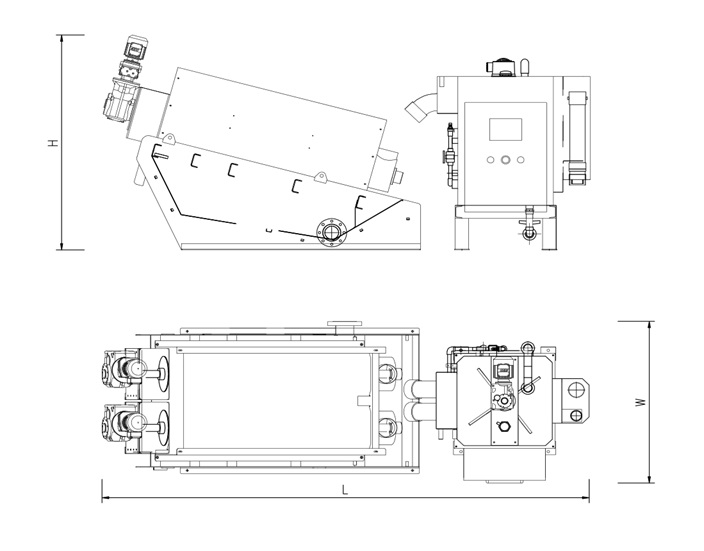
| Model | DS Capacity (kg/h) Min | DS Capacity (kg/h) Max | Spiral Diameter (mm) | Discharge Distance (mm) | Size L (mm) | Size W (mm) | Size H (mm) | Net Weight (kg) | Running Weight (kg) | Power (kW) | Washing Q (L/h) |
|---|---|---|---|---|---|---|---|---|---|---|---|
| DL202 | 18 | 30 | 200 * 2 | 350 | 2500 | 935 | 1270 | 470 | 730 | 1.11 | 64 |
| DL301 | 30 | 50 | 310 * 1 | 495 | 3255 | 985 | 1600 | 850 | 1320 | 0.74 | 40 |
| DL302 | 60 | 100 | 310 * 2 | 495 | 3455 | 1295 | 1600 | 1200 | 2230 | 1.11 | 80 |
| DL303 | 90 | 150 | 310 * 3 | 495 | 3605 | 1690 | 1600 | 1520 | 3080 | 1.86 | 120 |
| DL352 | 120 | 200 | 350 * 2 | 580 | 4240 | 1550 | 2190 | 1950 | 3400 | 3.75 | 144 |
| DL353 | 180 | 300 | 350 * 3 | 580 | 4460 | 2100 | 2190 | 2600 | 4850 | 6 | 216 |
| DL402 | 120 | 200 | 410 * 2 | 585 | 4140 | 1550 | 2250 | 2450 | 3400 | 3.75 | 144 |
| DL403 | 180 | 300 | 410 * 3 | 585 | 4420 | 2100 | 2250 | 3350 | 4850 | 6 | 216 |
Notes extracted from municipal wastewater plant full-scale test reports:
1. Polymer dosage figures calculated based on medium organic activated sludge; livestock manure sludge requires 15–30% higher polymer input.
2. When inlet sludge TS drops below 0.8%, a gravity thickener pre-treatment unit is strongly recommended to stabilize dewatering output.
3. Maximum mud cake solid content relies on coordinated tuning of screw speed and outlet backpressure; single parameter adjustment cannot reach optimal dryness targets.
(4)Cross-Equipment Performance & Operation Cost Comparison Table (Table 2)
| Evaluation Index | Stacked Screw Sludge Dewaterer | Decanter Centrifuge | Belt Filter Press | Plate-and-Frame Filter Press |
|---|---|---|---|---|
| Continuous operation mode | 24h unattended automatic | 24h automatic, high noise | Semi-continuous, regular cloth washing | Batch cycle operation only |
| Risk of clogging | Extremely low (self-clean stacked rings) | Medium (sludge floc shear damage) | High (filter cloth pore blockage) | Very high (filter cloth residue buildup) |
| Average daily maintenance time | 0.3–0.8 hours | 1.5–2.2 hours | 2.5–4 hours | 4–6 hours |
| Power consumption per m³ sludge (kWh) | 0.6–1.1 | 2.2–3.5 | 1.3–1.9 | 1.0–1.5 |
| Polymer consumption relative index | Baseline (100%) | +22% higher | +16% higher | +8% higher |
| Required installation floor space | Minimal, compact layout | Medium, heavy foundation needed | Large supporting platform | Extra large civil foundation |
| Initial equipment investment cost | Medium-low | High | Medium-high | Medium |
| Suitable sludge type | Activated sludge, manure, food, printing dye sludge | High-density inorganic sludge | Medium-concentration municipal sludge | Hard, low organic industrial sludge |
| Long-term annual running cost | Lowest (low chemical & labor cost) | Highest (power + wear parts) | Medium-high (cloth replacement cycle 3–8 months) | Medium (high labor expense) |
Field data source: Deswater 2022 full-scale municipal wastewater plant long-term monitoring research. Plant operators running screw dewaterers reported average annual operational cost savings between $7,200 and $24,500 depending on daily sludge throughput volume.
(5)Industrial Application Scenarios & Matching Model Selection Guide (Table 3)
| Wastewater Industry Type | Typical Inlet Sludge Characteristics | Recommended Dewaterer Model | Expected Mud Cake TS Range | Auxiliary Equipment Suggestion |
|---|---|---|---|---|
| Municipal domestic sewage plant | Activated sludge, inlet TS 0.8–3.5% | DS202 / DS303 | 18–20% | Automatic polymer dosing unit, sludge storage tank |
| Livestock breeding farm (pig/cattle) | High fiber organic sludge, low initial solid | DS101 / DS202 | 17–19% | Pre-screener to remove large straw impurities |
| Food & beverage processing factory | High oil & protein sludge, easy floc breakdown | DS303 / DS404 | 18.5–20.5% | Heated polymer mixing tank to boost floc stability |
| Textile printing & dyeing factory | Fine dyestuff particle sludge, high filtrate turbidity risk | DS303 / DS404 | 19–21% | Two-stage flocculation mixing system |
| Containerized decentralized sewage station | Small daily sludge volume, limited installation space | DS101 | 17.5–19.5% | Integrated all-in-one flocculation & dewatering unit |
| Large chemical industrial park | High-volume mixed inorganic & organic sludge | DS404 / DS505 | 19.5–21.5% | Gravity thickener + sludge homogenization |
(6)Core Factors That Directly Impact Screw Dewatering Machine Performance
Multiple sets of orthogonal experimental data from 2023 MDPI interactive factor analysis papers prove three variables create the largest impact on final dewatering results: screw rotation speed, outlet backpressure value, and incoming sludge flocculation quality. Many on-site operators only adjust one parameter blindly, resulting in unstable mud cake dryness or excessive filtrate water carryover of solid particles.
(7)Screw Rotational Speed Tuning Logic
Low screw RPM (10–20 RPM) extends sludge residence time inside the compression chamber, generating longer mechanical extrusion time and drier mud cake. However, excessively low rotation reduces total hourly sludge processing capacity. For sludge with high organic fiber content such as livestock manure, engineers suggest operating at 12–18 RPM to prioritize mud cake dryness. For high-throughput municipal plants prioritizing processing volume, 25–32 RPM delivers larger hourly output with slightly reduced solid content (a 1–1.5% TS drop is typical).
CFD flow field simulation results indicate rotation speed above 35 RPM creates strong turbulence inside the stacked ring gaps, breaking formed sludge flocs and raising filtrate solid loss rate by over 28%. Operators should avoid sustained high-speed running unless sludge pre-thickening equipment is installed upstream.
(8)Outlet Backpressure Regulation Rules
The backpressure plate’s compression resistance determines internal chamber pressure, the primary driver for removing bound water inside sludge flocs. The 2023 MDPI test sets 5 kPa as the optimal baseline pressure for general municipal activated sludge; increasing pressure to 7–9 kPa lifts mud cake TS by 1–2% but increases screw motor load and accelerates wear on stacked ring components. For abrasive industrial sludge containing sand or metal particles, long-term high backpressure will shorten the service life of moving ring assemblies by roughly 40%.
(9)Inlet Sludge Concentration & Flocculation Control
When raw sludge TS falls below 1%, the gravity thickening zone cannot remove enough free water, overloading the compression segment and leading to thin, low-solid mud cake. If site space cannot fit a gravity thickener, partial sludge recirculation back to the mixing tank can raise inlet solid concentration. Uneven polymer mixing creates uneven floc size, which causes fluctuating filtrate quality; continuous online polymer dilution and stirring is mandatory for stable long-run performance.
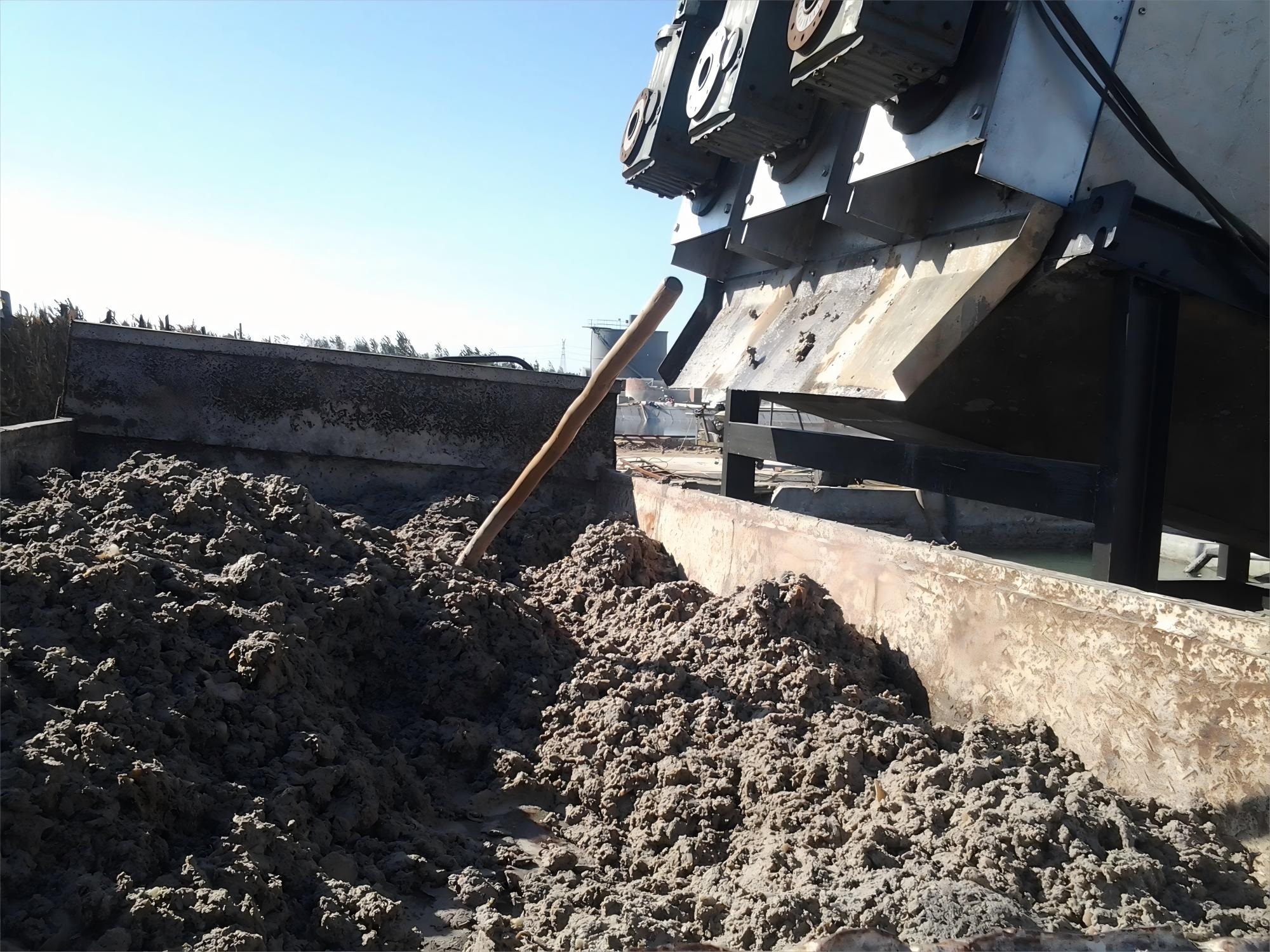
III.Real Full-Scale Municipal Wastewater Plant Operation Case Study
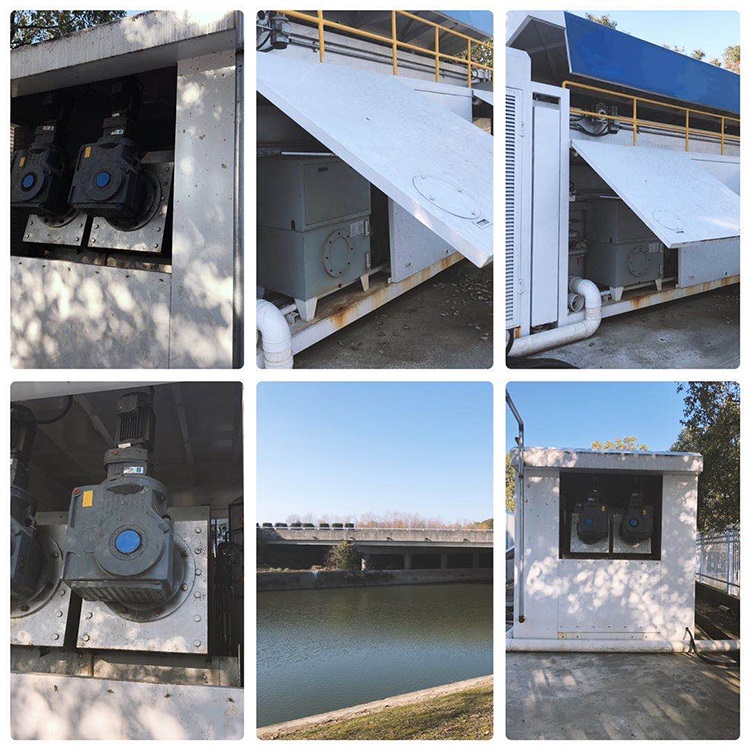
This practical case extracts long-term monitoring data from a mid-sized municipal sewage treatment plant documented in Deswater’s 2022 full-scale research paper. The plant handles 22,000 m³ daily domestic wastewater, producing raw activated sludge volume of approximately 9.5 m³ per hour before thickening.
Before upgrading to a DS303 stacked screw sludge dewaterer, the facility operated two belt filter presses. The old system required two full-time maintenance workers for cloth washing, replacement and daily inspection, consuming 1.7 kWh power per cubic meter of sludge, with average polymer consumption of 14.2 g per kg dry sludge. Mud cake solid content stabilized around 14–16%, requiring extra drying treatment before landfill transportation.
After installing the DS303 screw dewatering machine paired with an automatic Polymer Dosing System, the plant recorded measurable improvements within one month of continuous operation:
1. Labor requirement cut from two dedicated maintenance staff to part-time daily inspection (only 30 minutes routine check per shift)
2. Unit power consumption dropped to 0.92 kWh/m³ sludge, reducing monthly electricity expense by roughly $1,180
3. Average polymer dosage fell to 10.4 g per kg dry sludge, slashing monthly chemical procurement cost by 27%
4. Steady mud cake TS maintained at 18.8–20.2%, eliminating secondary drying steps and lowering sludge transport tonnage by nearly 22%
5. No clogging or emergency shutdown incidents recorded over 12 consecutive months of non-stop running
The plant’s engineering manager noted the compact footprint allowed installation inside the original filter press building without additional civil expansion work, saving over $18,000 in construction investment. This real-world case clearly demonstrates how screw sludge dewatering hardware delivers combined labor, chemical, power and logistics cost savings for medium-scale municipal treatment facilities.
IV. Practical Optimization Tips to Boost Screw Dewatering Machine Working Efficiency
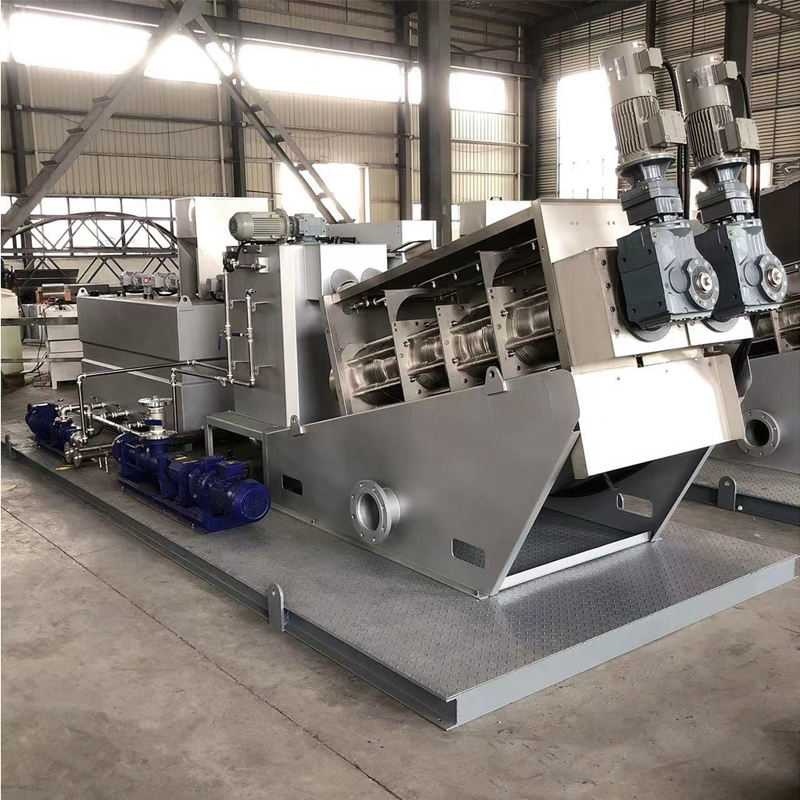
Based on experimental optimization data from ETH Zurich’s small-scale screw press design thesis, we sorted easy-to-implement on-site tuning tips that do not require equipment modification or large capital investment:
1. Match polymer molecular weight to sludge composition: High organic activated sludge works best with medium-anionic polymer; livestock manure with high fiber requires higher molecular weight flocculants to form sturdy flocs that resist shear inside the screw chamber.
2. Maintain consistent sludge inflow rate: Sudden spikes or drops in incoming sludge volume break stable flocculation balance. Install buffer sludge storage tanks to smooth out flow fluctuations from secondary clarifiers.
3. Conduct regular light self-cleaning cycles: Once per 24-hour shift, inject clean water through the filtrate channel for 5–10 minutes to wash tiny fine particle residue off stacked ring gaps, preventing gradual gap narrowing that lowers filtrate drainage speed.
4. Seasonal parameter adjustment for temperature changes: Low winter water temperature slows polymer dissolution and weakens floc strength. Raise polymer solution mixing tank temperature by 8–12°C and slightly reduce screw rotation speed during cold months.
5. Inspect stacked ring wear quarterly: Moving rings experience minor abrasion from sludge particles; uneven wear creates enlarged gaps that let fine solids escape into filtrate. Timely replacement of heavily worn ring sets restores original dewatering efficiency.
Many plant operators overlook minor seasonal and flow fluctuation adjustments, leading to a permanent 10–15% loss of potential dewatering performance without realizing simple parameter tweaks can recover full design throughput.
V. Conclusion – Is a Screw Sludge Dewatering Machine the Right Dewatering Solution for Your Project?
From small containerized sewage treatment units for remote construction sites to large municipal wastewater plants processing tens of thousands of cubic meters of domestic wastewater daily, there are sized screw dewaterer models to match every throughput requirement. The technical parameter table, cross-equipment cost comparison chart and industry matching guide included in this article serve as direct reference tools for procurement engineers and plant managers to shortlist suitable hardware without relying on incomplete product brochures.
If your project struggles with frequent filter media blockages, excessive chemical consumption, high daily maintenance labor costs or limited installation floor space, evaluating a stacked screw sludge dewatering machine is a logical next step. Our engineering team can provide customized capacity calculation, parameter matching and layout design plans tailored to your unique sludge concentration, industry wastewater type and target mud cake dryness requirements. Reach out via our contact form to receive personalized equipment selection proposals with full operational cost forecasting for your facility.
Name: Ashely Li
Mobile:+8613961861780
Tel:+8613961861780
Whatsapp:8613961861780
Email:info@dagyee.com
Add:Room 302, Building 11-4, Hongyi Road, Xinan Town, Xinwu District, jiangsu Province, China