 English
 Chinese

info@dagyee.com
+8613961861780

Generally speaking, we know that for situations with high flow rate, high dirt load but with relatively coarse filtration accuracy, bag-type filters are suitable. For situations that require precise filtration and where the installation space is relatively limited, cartridge-type filters are more suitable.
However, upon further investigation, you will find that in addition to bag-type and filter-element type options for the filter, there are also clamping-type and flange-type options, as well as differences in materials.
Quick Answer:
Bag Filter or Cartridge Filter: If the flow rate is high and there are many impurities, and the precision requirement is not strict (1–200 μm), choose the bag filter. If precise filtration is needed (0.1–1 μm), choose the cartridge filter.
Clamp or Flange: When the pressure is lower than 1.0 MPa, frequently cleaned (CIP), and the pipe diameter is ≤ 2 inches, choose the clamp type. When high pressure (≥ 1.6 MPa) is involved, and there is severe vibration or the pipe diameter is ≥ 4 inches, choose the flange type.
Material Selection: For neutral or weakly corrosive water environments, SS304 is selected. For seawater, high chloride or acidic fluid environments, SS316L is chosen. For low-pressure strong acid/strong base environments, PP/FRP is used.
Maintenance: The filter system needs to be frequently checked for the pressure difference at the inlet and outlet. If the O-ring is aged or damaged, replace it promptly.
This blog will start by comparing bag filters and cartridge filters, then discuss the selection between clamp-type and flange-type; the considerations regarding materials; the product advantages of DAGYEE; a real-world brewery case; the key points for installation and maintenanceand FAQto helpyou choose, install and maintain the water filter.
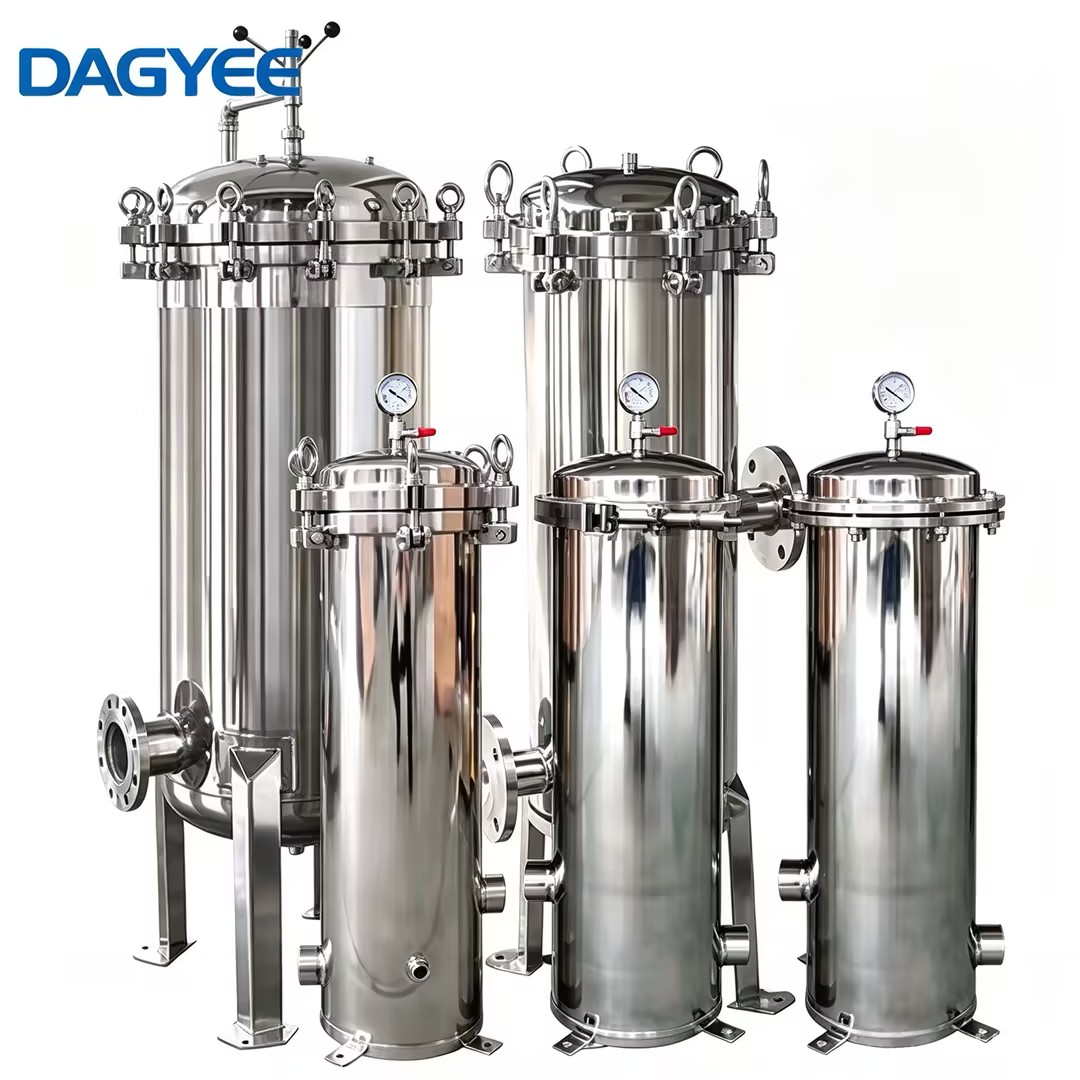
I.Bag Filter vs. Cartridge Filter (Core Differences)
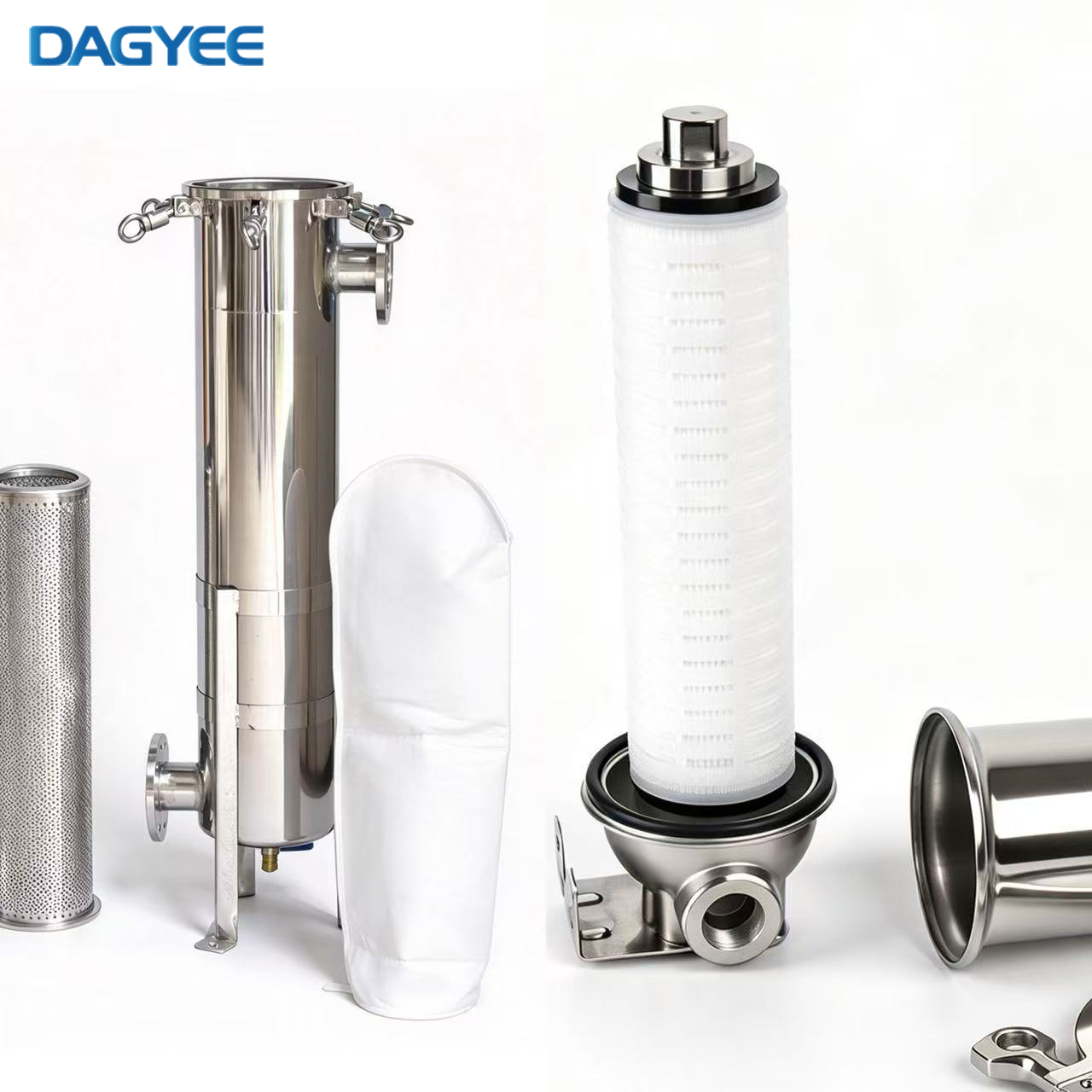
The Core Differences at a Glance
Comparison Dimension
Bag Filter
Cartridge Filter
Filtration Rating
Coarser. Typically 1–200 μm. Good for catching sand, debris, and fibers.
Highly precise. Typically 0.1–100 μm, capable of absolute filtration (e.g., sterile filtration).
Dirt-Holding Capacity
Massive. The inside of the bag acts like a large pocket, holding a huge amount of solids before clogging.
Lower. Pleats offer surface area, but the tight gaps blind quickly—especially in dirty water.
Change-out Frequency
Low when handling dirty water.
If used directly on dirty water, you might change elements multiple times a day.
Media Cost
Cheap. A single filter bag is inexpensive.
Expensive. Especially for pleated, PTFE, or specialty media.
Maintenance
Quick to change, but heavy and prone to dripping when filled with sludge.
Cleaner to handle, but loading dozens of cartridges one by one can be time-consuming.
Bypass Risk
Relatively low. Only one main O-ring at the top to seal.
Higher. Every cartridge has O-rings at both ends. If even one isn't seated right, dirty water bypasses the system.
Summary:
If the liquid to be processed has a large flow rate, high solid content, and the required filtration accuracy ≥ 5 μm, select a bag filter.
If the liquid to be processed has a low flow rate, few impurities, and high accuracy requirement (0.1 - 1 μm), select a cartridge filter.
For liquids requiring both large flow rate and high filtration accuracy, the common practice is to install a bag filter upstream, followed by a cartridge filter.
II.Clamp vs. Flange Connections: Which is Right for You?
Many people will also struggle to decide between Clamp-type and Flange-type. We can make the judgment based on the following three aspects.
1. Choose based on industry requirements
If you are in the food, beverage, pharmaceutical or fine chemical industries and your production line needs to be cleaned daily (CIP), or if filter elements need to be replaced frequently. The clamp design allows operators to open and close the housing instantly for quick cleaning and element replacement.
If you are in the heavy chemical, petroleum or high-pressure water treatment industries, with high pressure and strong vibration, and filter element replacements are not frequent. Choose the flange structure to ensure safety.
2. Based on pressure conditions
If the working pressure is lower than 1.0 MPa, the clamp is completely fine. As long as the design is reasonable and the sealing ring is selected appropriately, there will be no leakage.
However, if the pressure reaches 1.6 MPa or higher, directly choose the flange. When using clamps in high-pressure situations, it may lead to safety accidents.
3. Based on pipeline conditions:
If the pipeline diameter is 2 inches or smaller, using clamps is very suitable.
If the pipeline diameter reaches 4 inches or larger, the hardware becomes too heavy for a single person to handle safely. In these cases, always specify a bolted flange connection.
A common solution: Select the cover and the interface separately
Many people confuse "how to open the cover" and "how to connect the pipe". In industrial sites, the smartest approach is to mix and match:
Use the clamp for the cover: It is convenient for your workers to quickly replace the filter bag/filter element.
Use the flange for the inlet and outlet pipelines: It is convenient for connecting the hard pipes at the site, resistant to vibration, and leak-proof.
This "upper clamp, lower method" design not only maintains the convenience of maintenance, but also adheres to the safety bottom line of the pipeline.
III.What are the material considerations
|
Application Environments |
Recommended materials |
Key reasons: |
|
Neutral clear water, low pressure, priority to budget |
Carbon steel (with rubber lining / epoxy coating) |
The lowest cost, sufficient strength, but it must be treated for corrosion prevention. |
|
General industrial water, weak corrosion, preferred based on cost-effectiveness |
SS304 |
Resistant to weak acids and alkalis, smooth surface, high mechanical strength |
|
Contains chloride ions, seawater, high salt content, chemical media |
SS316L |
Contains molybdenum, has a much higher ability to resist pitting and chloride ion corrosion than 304. |
|
Strong acids and strong bases, low pressure and normal temperature, no severe impact |
PP / FRP |
Non-metallic materials have extremely strong corrosion resistance, but have weak pressure-bearing and temperature resistance capabilities, and are afraid of water hammer. |
|
Food, pharmaceuticals, high hygiene requirements |
SS316L + Mirror Polished |
Hygiene grade standard. The Ra value of the inner surface directly affects bacterial growth and cleaning effectiveness. |
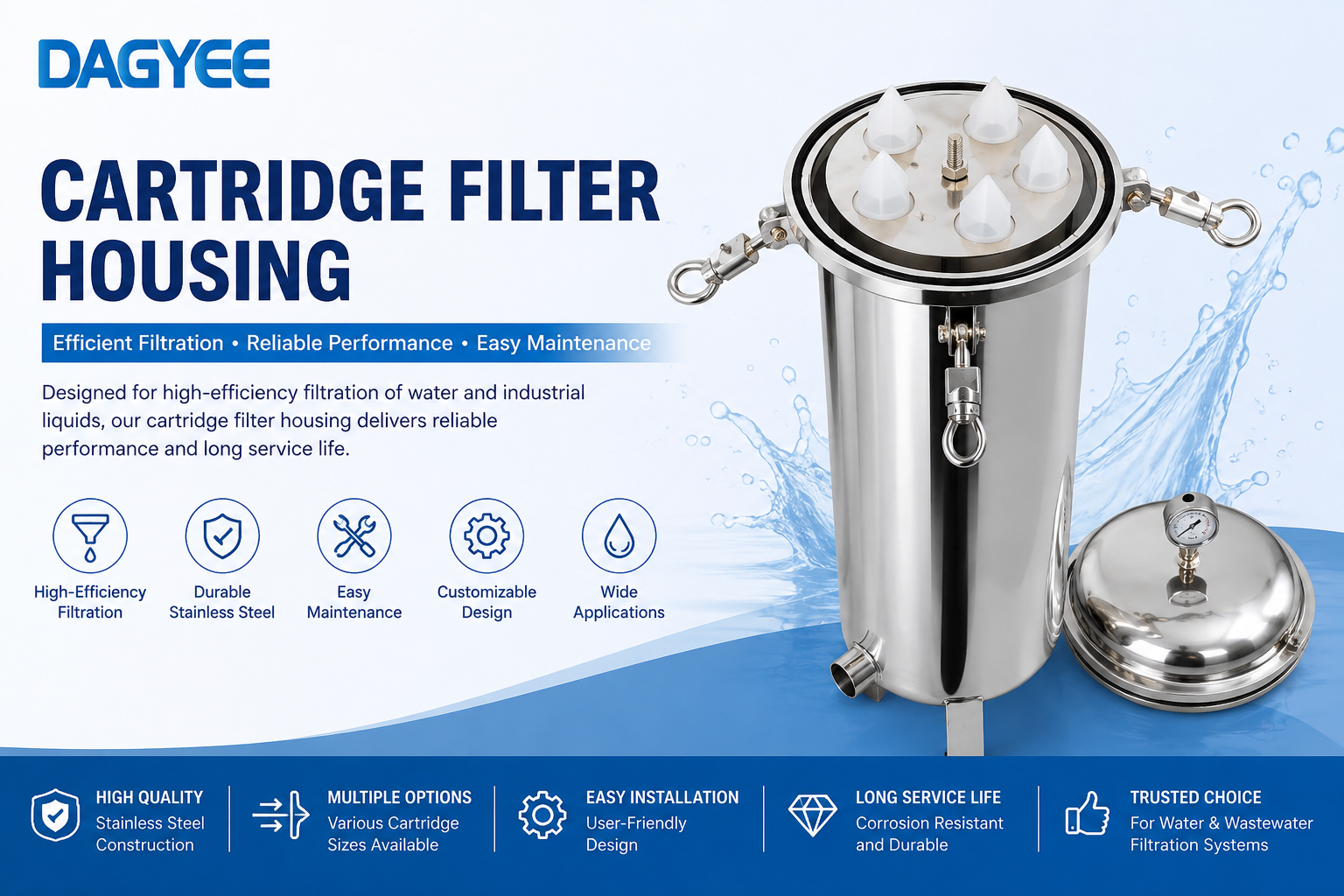
IV.The product advantages of DAGYEE
V.Real-World Application: A Brewery's Filtration Upgrade
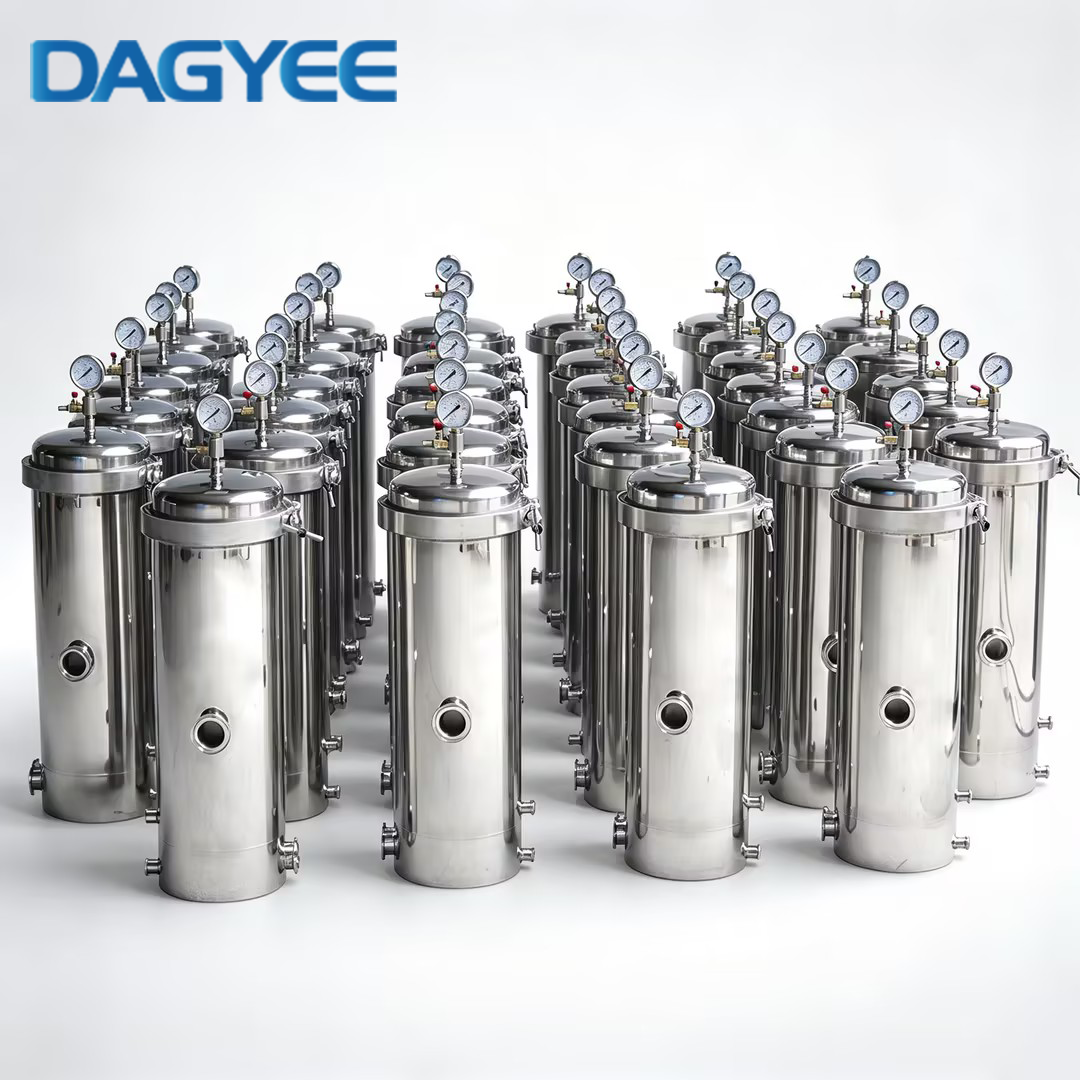
One of our clients is engaged in the beer business. He eventually chose the 5 Cartridges filter Housing 20'' specification from DAGYEE. The specifications are as follows:
|
Model |
DYG-5-20'' |
|
Material |
SUS316 |
|
Applicable Filter Cartridges |
Industrial PP Filter Cartridges String Wound Filter Cartridges Stainless Steel Filter Cartridges |
|
Filtration accuracy |
0.1-200UM |
|
Connection Type |
With a clamp /BSP female |
|
Surface treatment |
Mirror reflection |
|
Applicable field |
Water treatment Beveragepharmaceutical Electronics Chemical Petroleum Paint Glue |
|
Housing Dimensions (mm) |
Ø219mm*830mm |
|
Max. Flow Rate (m3 /h) |
5 |
|
Max. Operating Conditions (bar/°C) |
6/150 |
|
Inlet/Outlet (BSP female) |
1" |
|
Length of Filter Cartridge |
20" |
|
No. of Filter Cartridges |
5 |
|
Max. Cartridge Outside Diameter |
Ø219mm |
Due to the low flow rate of the brewery, but the high filtration accuracy is required, the Cartridges filter was chosen. Since it is used to filter the fermented beer, it is necessary to ensure that no bacteria can grow. Before the end of each working day, CIP (in-situ cleaning) must be carried out.
The multi-core (5-core) structure was adopted because the flow rate of the beer is approximately 5 tons per hour, which can effectively share the pressure drop.
The clamp-type design was used, which makes it convenient for the operators to open the cover and replace the filter element with their bare hands. This process only takes 10 minutes and is completely compatible with the CIP cleaning procedure.
We chose to use SS316L as the material and perform mirror polishing treatment. This can prevent the accumulation of dirt. Why not choose SS304? It is because beer is acidic, and SS304 is prone to problems in an acidic environment.
The client reported a significant reduction in downtime and improved product clarity.
VI.Installation and Maintenance key points
Pleated cartridge filter Install instruction
1. Please clean filter shell carefully before using.
2. Connect cartridge filter with other in-line filtering system. Please check inlet and outlet install direction.
3. Open the filter top cover to check cartridge condition: O-ring’s sealing and its position.
4. Users can use wetting agent (Water e.g) to wet O-ring and cartridge socket.
5. Hold the cartridge near O-ring side, insert it into socket vertically.
6. Insert all cartridges, fixing with press plate and covering with top cover.
Open vent valve at the top of out shell. Turn on inlet valve a bit, let liquid into shell. Turn off vent valve till liquid comes into shell entirely and leak from vent valve. Adjust outlet valve gradually until turn on it fully. Turn on inlet valve slowly to adjust pressure drop to a data of 0.02MPa.
Pleated cartridge filter Operation instruction
1.If cartridge filter is used at desalt system, please read exclusive operation instruction.
2.If for normal use, please read below:
1. Open inlet valve, vent valve to let filter house full of water. Then open outlet valve, close vent valve to adjust filter’s flow rate.
2. Cartridge using period usually can be inspected by pressure gauge. Normally the max differential pressure is 0.15MPa. When pressure alarms, it’s time to close inlet and outlet vale, and to replace cartridge.
3. Open vent valve, drain vale and replace new cartridges."
Notes in operation
1. Avoid pressure impact, reverse pressure is forbidden.
2. Replace cartridge when differential drop is big than 0.3MPa, or flow rate down obviously.
3. If filter no need work for a short time, soak cartridge in sterile solution, but don’t dry cartridge. User can pour sterile solution inside filter house, clean it before again use.
4. If users need steam sterilization for filter, make sure drain condense water, and steam pressure not exceed 0.1MPa, filter differential pressure not exceed 0.015MPa.
If users need disinfect wet cartridge, please use clean compress air absorb all liquid, or else, steam will destroy cartridge.
Ways for replace cartridge
1. Shut off the filter, disassemble man hole cover.
2. Switch off screws on cartridge, take out cartridge. Clean filter inside.
3. Take off o-rings at both side of cartridge, clean and insert them to new cartridges. Notice: please soak new cartridge 30minutes before using to make sure it’s wet.
4. Insert cartridge at the socket.
5. Put press plate, tight screws.
6. Place top manhole cover. Run the filter.
7. Open inlet valve, vent valve to let filter house full of water.
Close vent valve, open drain valve, and to look at outlet water condition. When water turns into clear, then filter can through into operation.Remark: please wash new cartridge before using.
Bag Filter Installation Guide
When installing, please follow the steps below:
1. Place the bag filter on the work position that needs to be filtered, connect the inlet and outlet flanges or pipe threads, and fix it; block the exhaust port, or install an exhaust valve. Connect the jacket type with the heat source.
2. Gently insert the metal inner net into the bag filter, making the inner net collar fit with the mouth of the bag filter.
3. Place the filter bag, making the filter bag ring and the inner net collar fit, then put the plate with the magnetic rod into the equipment to press the filter bag tightly.
4. Put the O-ring into the O-ring groove. The O-ring must not be twisted or deformed. For multi-bag filter machines, attach the filter bag pressure ring.
5. Hold the handle of the upper cover with one hand, and grasp the other end of the upper cover (for multi-bag filter machines, turn the top handwheel), align the upper cover with the mouth of the bag filter, slowly lower it, and naturally press it onto the O-ring and the filter bag ring.
6. After alignment, simultaneously tighten the two opposite cotter pins, and fully tighten all cotter pins (insert a short stick into the cotter ring to tighten them). Tight
7. Close the exhaust valve installed at the top of the bag filter.
8. Please check if all connection pipes are securely fastened and if the working pressure is within the allowable range.
9. Open the output valve. Open the heat source inlet valve, slowly increase the temperature to bring the filter machine temperature to the specified temperature.
10. Slowly open the input valve to allow the liquid to flow in slowly and fill the filter machine to prevent sudden liquid impact on the filter bags, which could cause rupture. Then observe for any leakage. If no leakage occurs, the filtration process can begin.
Daily Use and Maintenance
1. During daily operation, the filter system needs to be frequently checked for the pressure difference at the inlet and outlet. When the pressure difference reaches 0.05 to 0.1 MPa, the filter bag should be replaced in time to prevent the filter bag from bursting and the support net from being damaged due to excessive pressure difference.
2. Correctly open the upper cover of the filter machine after filtration: Warning: Do not open the cover when there is pressure in the bag filter. Otherwise, the remaining liquid may spray out, causing liquid loss and personnel injury. Therefore, please strictly follow the following sequence:
(1) Close the input valve; close the output valve when there is pressure at the outlet.
(2) Confirm that the pipeline connected to the exhaust valve has been connected to a safe place or the suction port, then open the exhaust valve to prevent the liquid from causing harm and pollution to the staff and the surrounding environment.
(3) Check the pressure gauge to determine that the internal pressure is 0. At this time, the bag filter has been separated from the pipeline system.
(4) If there is a discharge valve, confirm that the discharged liquid is received at the recovery place, then open the discharge valve; wait until the remaining liquid in the bag filter is drained through the discharge valve, then close the discharge valve.
(5) Unscrew the lifting cap of the upper cover, lift the upper cover, and for multi-bag filter machines, rotate them to a certain angle.
3. Replace the filter bag.
4. Monitor the filtration quality: After the bag filter starts working, regularly check the pressure difference, even when replacing the filter bag. If the pressure difference suddenly drops, stop the filtration immediately and check if there is a leakage.
5. Pressurize and discharge the remaining liquid: When filtering high-viscosity liquids, compressed air can be introduced through the exhaust valve to accelerate the discharge of the remaining liquid and shorten the waiting time.
6. Clean the bag filter. If the bag filter continues to filter the same liquid, no cleaning is required. However, if it filters other types of liquids, the machine must be cleaned before it can be used.
7. Maintenance and replacement of O-ring: When using, the O-ring should be placed in the O-ring groove and aligned properly to avoid improper squeezing that causes the O-ring to deform; when not filtering, the O-ring must be removed and wiped clean. Replacement: If the O-ring is aged or damaged, replace it promptly.
VII.Frequently Asked Questions(FAQ)
Q1: Can I use a bag filter for high-precision filtration (e.g., 1 micron)?
A: No, it is not recommended. While you can find 1-micron filter bags, the fabric structure will blind very quickly when handling fine particles. The pressure drop will spike instantly, forcing you to change the bag multiple times a day. For absolute filtration below 5 microns, always use a cartridge filter.
Q2: What is the maximum pressure for a clamp-type filter housing?
A: Clamp-type (quick-opening) connections are generally rated for working pressures up to 1.0 MPa (about 150 PSI). If your system pressure reaches 1.6 MPa or higher, you must switch to a bolted flange connection to prevent seal failure and safety hazards.
Q3: How do I know when to replace the filter bag or cartridge?
A: Always rely on the differential pressure (DP) gauge.
For bag filters, replace the bag when the DP reaches 0.05 to 0.1 MPa.
For cartridge filters, replace the elements when the DP reaches 0.15 MPa.
Never let the pressure exceed these limits, or the media will burst and bypass unfiltered water.
Q4: Why did the pressure drop suddenly decrease during operation?
A: A sudden drop in differential pressure usually indicates a bypass leak. This means the filter bag has ruptured, or an O-ring on the cartridge is torn or not seated properly. Stop the system immediately and inspect the seals.
Q5: Can I use SS304 for seawater filtration?
A: No. Seawater contains high levels of chloride ions, which cause pitting and stress corrosion cracking in SS304. For seawater, high-salt wastewater, or chemical solvents, you must use SS316L, as the molybdenum content provides the necessary resistance to chloride attack.
Not sure which filtration setup fits your plant? Send your **flow rate (m³/h) and target micron rating** to our engineers at [info@dagyee.com]. We will size the perfect bag or cartridge housing for your application within 24 hours.

Name: Ashely Li
Mobile:+8613961861780
Tel:+8613961861780
Whatsapp:8613961861780
Email:info@dagyee.com
Add:Room 302, Building 11-4, Hongyi Road, Xinan Town, Xinwu District, jiangsu Province, China