English
 Chinese
info@dagyee.com
+8613961861780

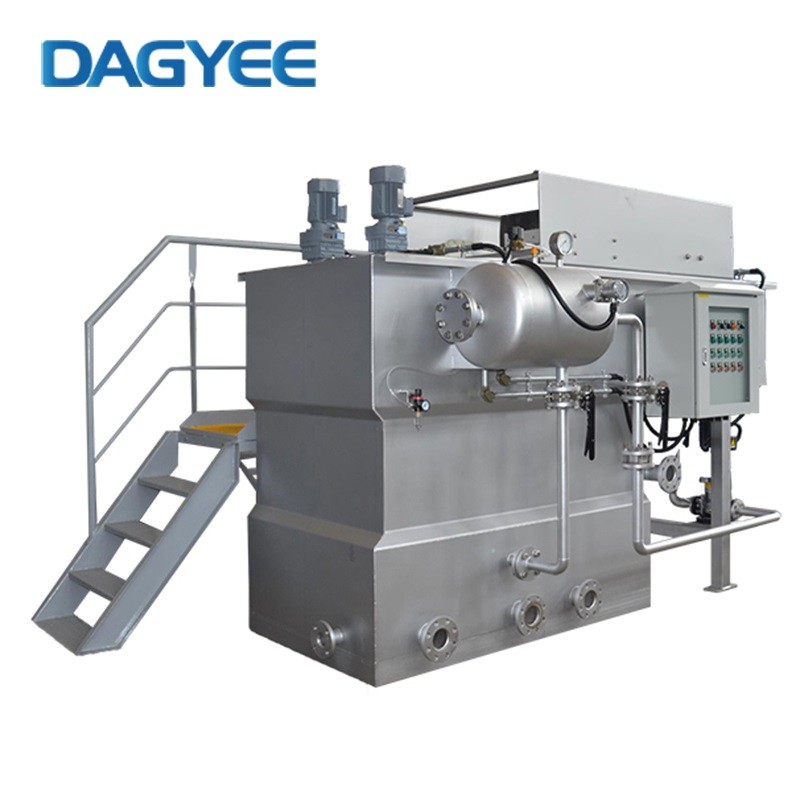
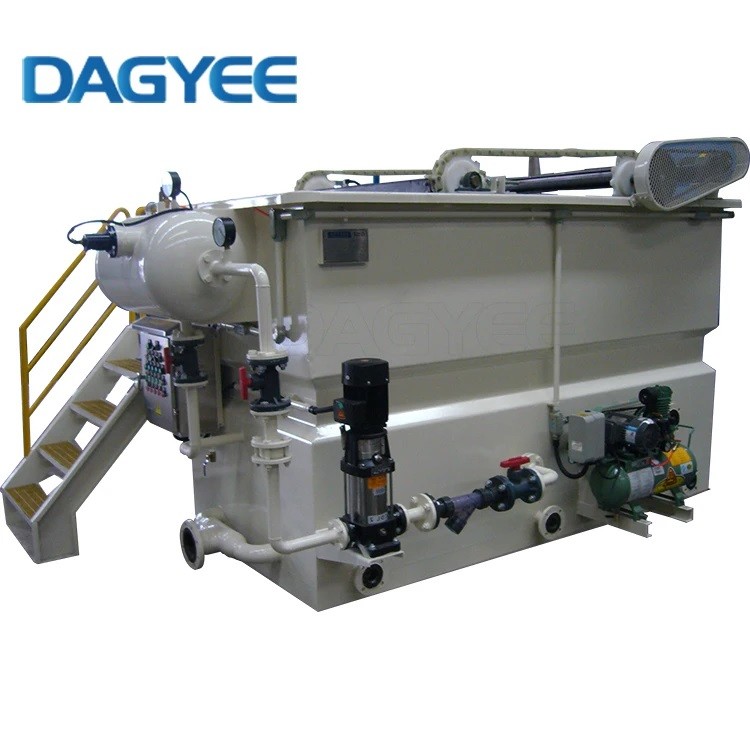
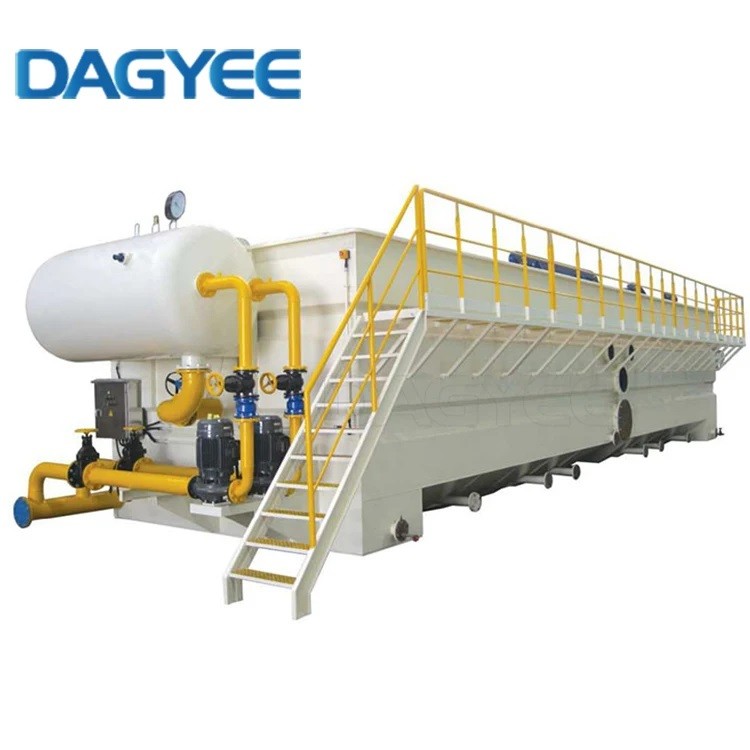
Dissolved air flotation description
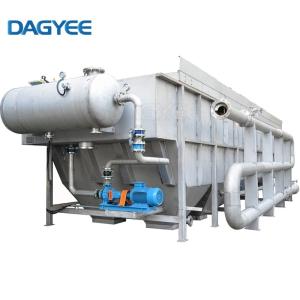
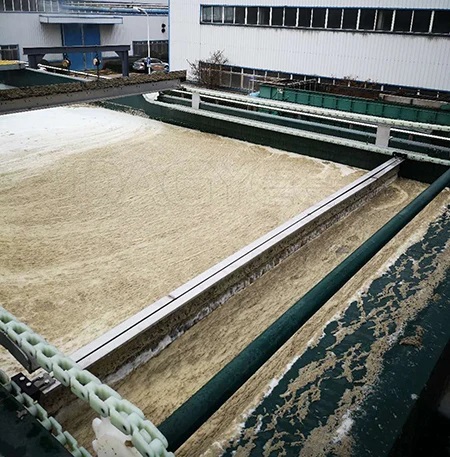
Dissolved air flotation (DAF) is a water treatment process designed to remove oils, solids, and greases. In fact, the process helps clarify wastewaters – and other waters – by eliminating different types of suspended matter. The DAF process dissolves air in the water under pressure – then releases it at atmospheric pressure. The dissolved air flotation process takes place in a tank basin, which is ideal for catching and eliminating suspended matter. In fact, the released air creates tiny bubbles, which conform to the suspended matter and cause it to rise to the surface. Skimmers or a similar device then eradicate the substance.
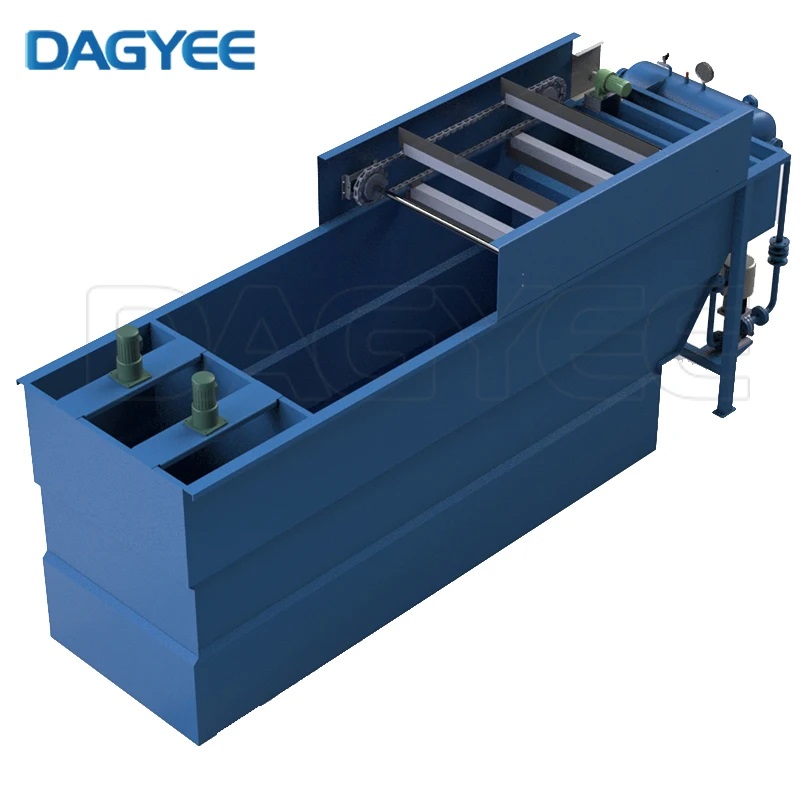
Dissolved air flotation principle
The DAF methodology involves several key steps to effectively remove pollutants from wastewater:
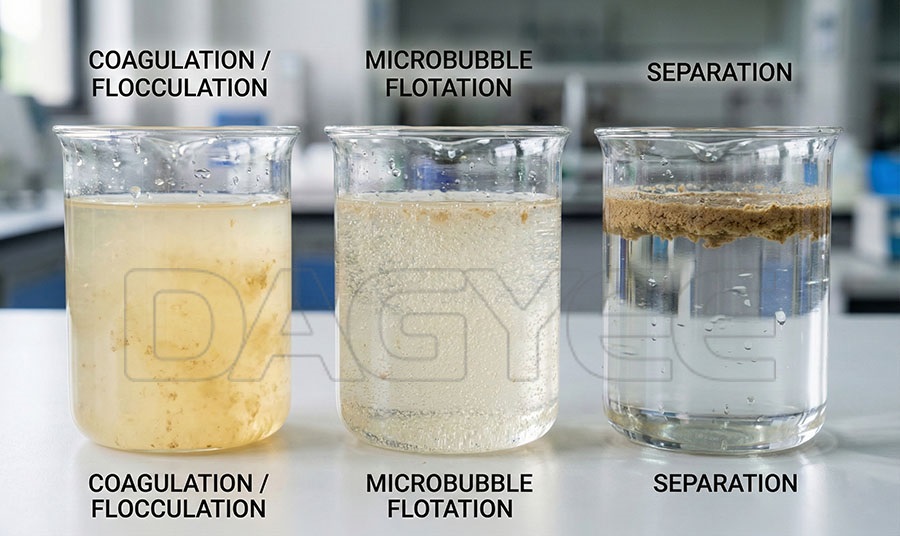
Air Dissolution: Air is dissolved into the wastewater under pressure. When the pressure is released in the flotation tank, the air forms microscopic bubbles that help in the separation process.
Coagulation: This initial step involves adding coagulants such as aluminum sulfate or ferric chloride to destabilize particles and promote their aggregation into larger clusters called flocs. Coagulants neutralize the negative charges on suspended particles, allowing them to clump together.
Flocculation: Following coagulation, flocculation gently mixes the wastewater to form larger, heavier flocs. These flocs are easier to remove as they either attach to microbubbles and float to the surface or settle at the bottom.
Flotation and Removal: The formed flocs, along with air bubbles, rise to the surface where they are skimmed off by the skimmer and collected for further processing or disposal.
By integrating these steps, DAF enhances the sedimentation and flotation of pollutants, resulting in cleaner, clarified water that meets environmental standards.
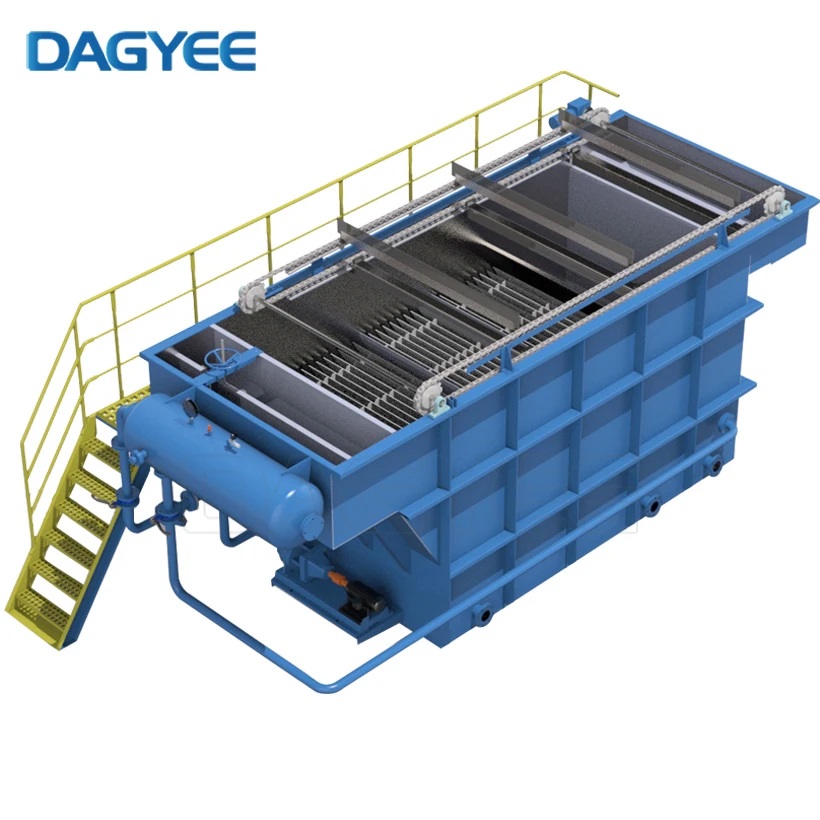
Dissolved air flotation technical sheet
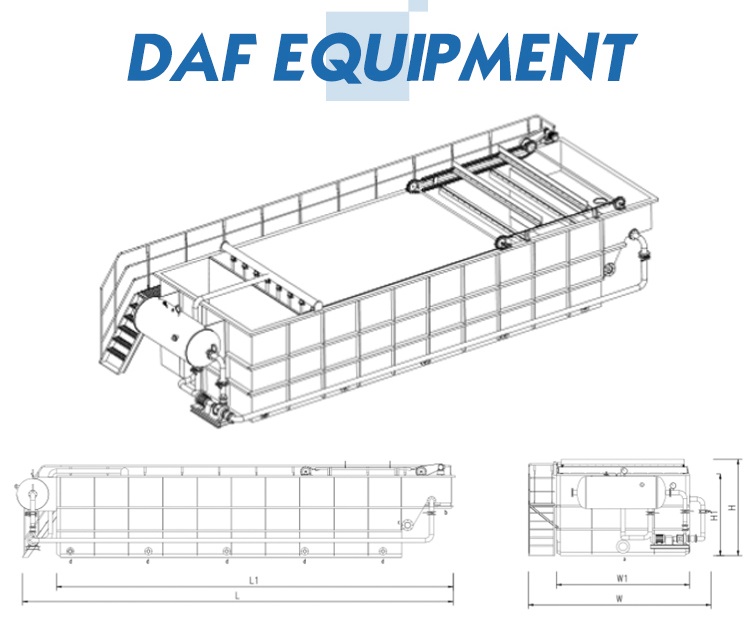
| DAF Model | Qm3/h | Piping Connections | Physical Dimensions(m) | Weight (Kg) | Operating Weight (Kg) |
|---|---|---|---|---|---|
| DAF-003 | 3 |
Inlet: DN50 Outlet: DN50 Sludge: DN100 Vent: DN100 |
L/L1: 3.7/2.8 W/W1: 2.4/1.16 H/H1: 2.2/1.7 |
1500 | 5000 |
| DAF-005 | 5 |
Inlet: DN80 Outlet: DN80 Sludge: DN100 Vent: DN80 |
L/L1: 4/3 W/W1: 2.4/1.16 H/H1: 2.2/1.7 |
1600 | 7000 |
| DAF-010 | 10 |
Inlet: DN100 Outlet: DN100 Sludge: DN100 Vent: DN100 |
L/L1: 4.65/3.8 W/W1: 2.7/1.36 H/H1: 2.4/1.9 |
2000 | 12000 |
| DAF-015 | 15 |
Inlet: DN125 Outlet: DN100 Sludge: DN150 Vent: DN100 |
L/L1: 5.6/4.5 W/W1: 2.9/1.66 H/H1: 2.5/2 |
2200 | 18000 |
| DAF-020 | 20 |
Inlet: DN150 Outlet: DN150 Sludge: DN150 Vent: DN100 |
L/L1: 5.9/4.8 W/W1: 3.2/1.96 H/H1: 2.5/2 |
3000 | 22000 |
| DAF-030 | 30 |
Inlet: DN150 Outlet: DN150 Sludge: DN150 Vent: DN100 |
L/L1: 6.8/5.5 W/W1: 3.2/2.16 H/H1: 2.7/2.2 |
3800 | 32000 |
| DAF-040 | 40 |
Inlet: DN200 Outlet: DN150 Sludge: DN150 Vent: DN100 |
L/L1: 8/6.7 W/W1: 3.6/2.6 H/H1: 2.7/2.2 |
5000 | 45000 |
| DAF-050 | 50 |
Inlet: DN200 Outlet: DN150 Sludge: DN150 Vent: DN100 |
L/L1: 8.4/7 W/W1: 3.6/2.6 H/H1: 2.7/2.2 |
5500 | 55000 |
| DAF-060 | 60 |
Inlet: DN250 Outlet: DN200 Sludge: DN150 Vent: DN100 |
L/L1: 9.9/8.4 W/W1: 3.8/2.8 H/H1: 2.9/2.4 |
6000 | 66000 |
| DAF-070 | 70 |
Inlet: DN250 Outlet: DN200 Sludge: DN150 Vent: DN100 |
L/L1: 10.4/9 W/W1: 3.8/2.8 H/H1: 2.9/2.4 |
6500 | 75000 |
| DAF-080 | 80 |
Inlet: DN250 Outlet: DN250 Sludge: DN150 Vent: DN100 |
L/L1: 10.8/9.4 W/W1: 4/3 H/H1: 2.9/2.4 |
7500 | 100000 |
| DAF-100 | 100 |
Inlet: DN300 Outlet: DN250 Sludge: DN150 Vent: DN100 |
L/L1: 12.1/10.6 W/W1: 4.2/3.2 H/H1: 2.9/2.4 |
9000 | 110000 |
| DAF-120 | 120 |
Inlet: DN300 Outlet: DN250 Sludge: DN150 Vent: DN100 |
L/L1: 12.5/11.4 W/W1: 4.4/3.4 H/H1: 2.9/2.4 |
10000 | 130000 |
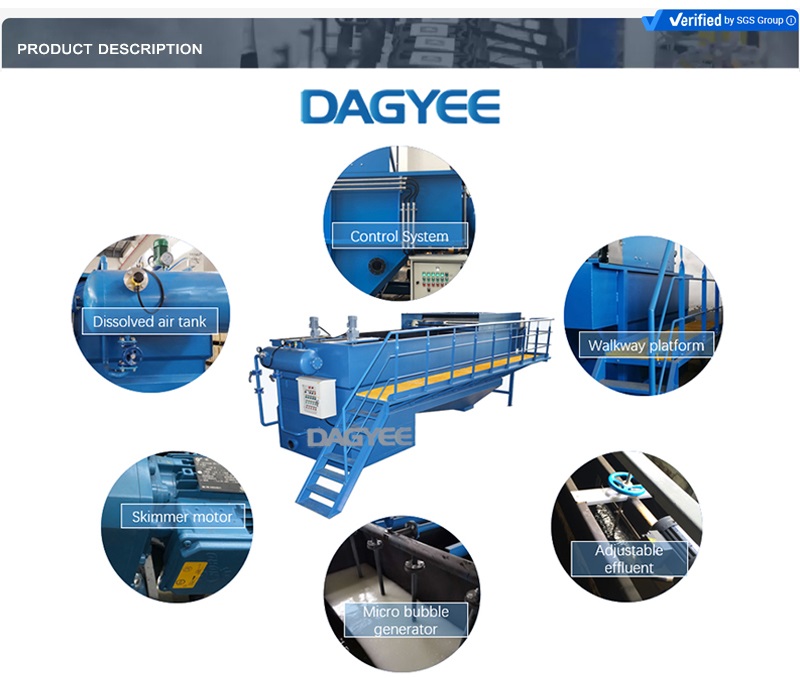
Dissolved air flotation process flow
Dissolved air flotation advantage
The effectiveness of DAF units lies in their ability to handle a variety of wastewater streams, making them indispensable across multiple industries. Whether in industrial settings dealing with complex contaminants or municipal systems facing large volumes of urban runoff, DAF units prove their versatility and efficiency. They are particularly renowned in industries such as food and beverage production, where they handle organic matter and fats with ease, and in the oil and gas sector, where the separation of hydrocarbons is critical. Furthermore, the technology is adaptable, with configurations allowing for the introduction of various chemicals to optimize performance based on specific treatment needs.
Beyond their application flexibility, DAF units offer significant advantages including high removal efficiency, low operating costs, flexibility in operation, and a compact footprint. This makes them a viable solution even for facilities with space constraints or those looking to upgrade their existing wastewater treatment infrastructure. However, it’s important to note that the complexity of these systems often necessitates skilled operators to manage and maintain optimal performance. Proper pre-treatment steps such as Coarse Screening, homogenization, sand removal, and coagulation-flocculation are also essential to ensure maximum efficiency and longevity of the DAF units.
Dissolved air flotation feature
The continuous evolution of DAF technology is driven by the need for greater efficiency and sustainability.
Energy Efficiency: Advances focus on reducing energy consumption through improved aeration systems and optimized flotation models. The development of ultra-fine bubble generators enables more efficient bubble-particle aggregation.
Chemical Dosing Optimization: Use of coagulant and flocculant aids in improving the agglomeration of particles prior to flotation, enhancing the removal efficiency and reducing chemical usage.
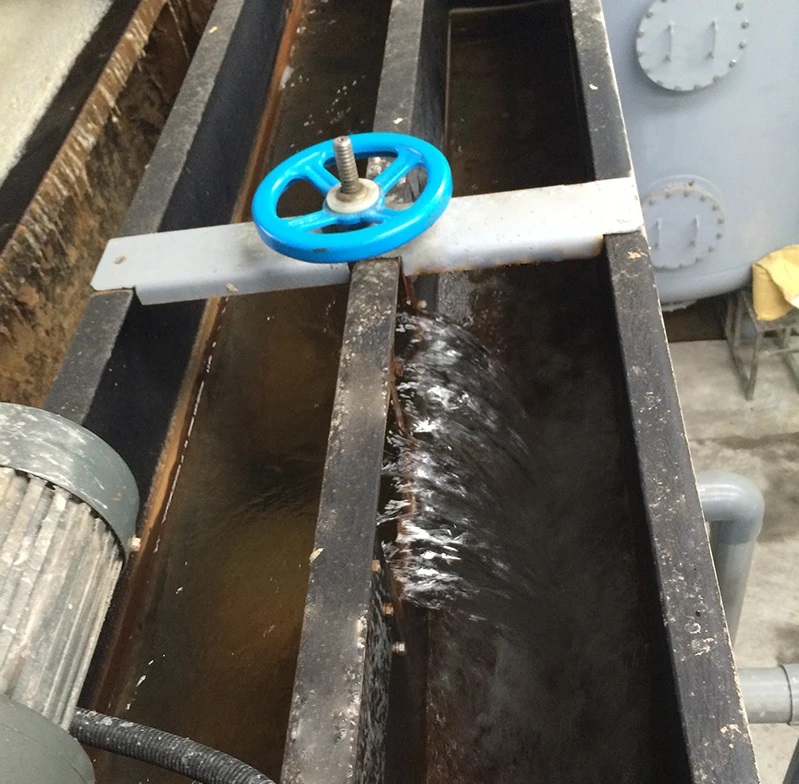
Automation and Control Systems: Modern DAF units often incorporate sophisticated control systems for optimizing operation, facilitating real-time monitoring and adjustment of process parameters to ensure optimal performance.
Dissolved air flotation application
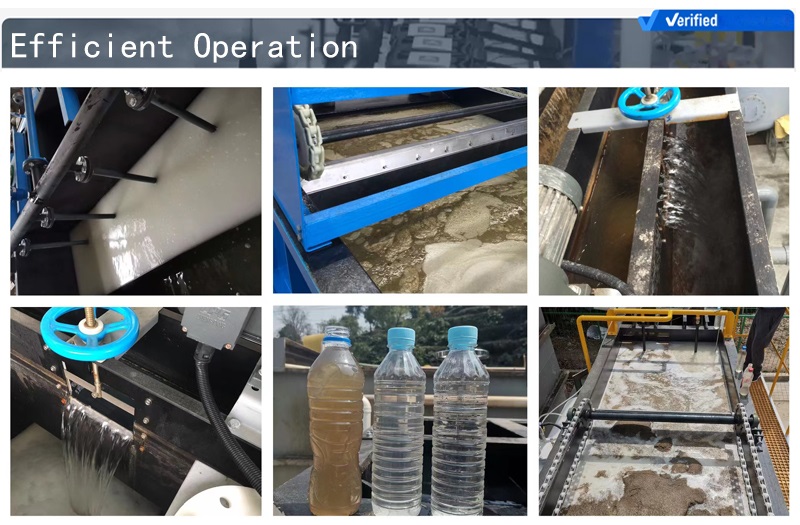
Wastewater Treatment DAF systems find applicability across multiple industrial sectors, addressing specific water treatment needs.Dissolved air flotation systems are commonly used in the following industries and production processes.
Petroleum, petrochemical and refineries
Natural gas processing plants
Pharmaceutical and cosmetics
Mining, quarrying and aggregate production
Water and wastewater treatment
Food processing
Commercial and industrial laundry
Pulp and paper production
Algae removal and desalination pretreatment
Pretreatment for downstream biological treatment systems
Name: Ashely Li
Mobile:+8613961861780
Tel:+8613961861780
Whatsapp:8613961861780
Email:info@dagyee.com
Add:Room 302, Building 11-4, Hongyi Road, Xinan Town, Xinwu District, jiangsu Province, China