 English
 Chinese
info@dagyee.com
+8613961861780

DAGYEE Screw Press Dewatering Systems: Comprehensive Technical FAQ
About This Guide:
This document is designed to serve engineers, plant managers, environmental consultants, and procurement officers who are evaluating sludge dewatering technologies. As a specialized manufacturer, DAGYEE focuses on tailoring Multi-Disk Screw Press solutions to meet specific sludge characteristics and discharge requirements. Unlike off-the-shelf trading companies, we engineer our units to fit your process.
Section 1: Fundamentals & Working Principles
Q1: What is a Multi-Disk Screw Press, and how is it different from a traditional screw press?
A Multi-Disk Screw Press (often called a Volute Dewatering Press) is distinct from a traditional high-pressure screw press used in food processing.
Traditional Screw Press: Uses a screw inside a perforated metal screen. It requires high pressure and often clogs easily with sticky sludge.
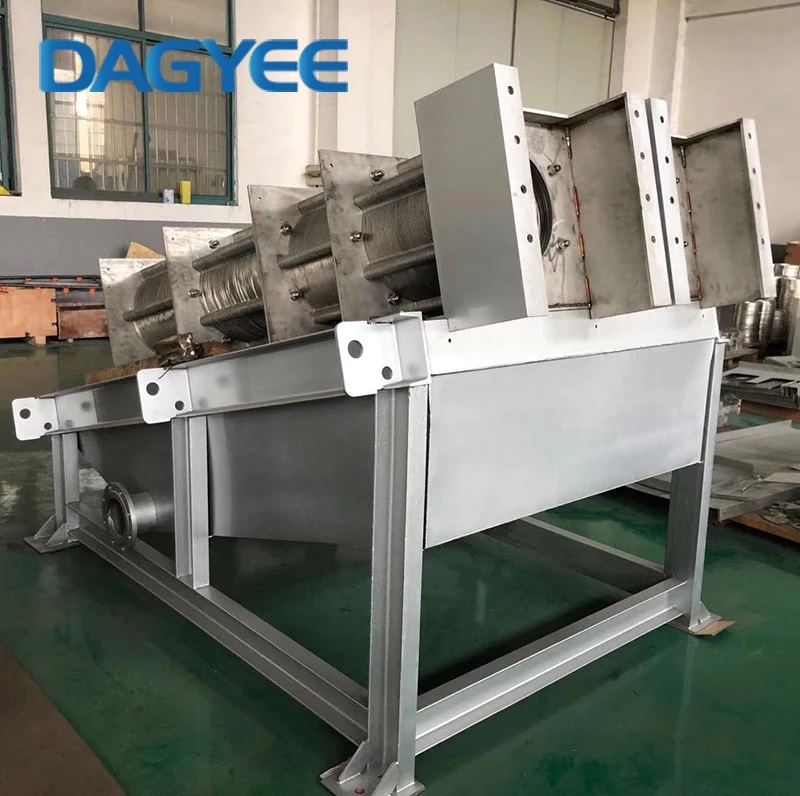
DAGYEE Multi-Disk Screw Press: Uses a unique filtration body consisting of a central screw shaft running through a series of rings. These rings are stacked: Fixed Rings and Moving Rings alternate.
As the screw rotates, it pushes the edges of the Moving Rings against the Fixed Rings.
This constant movement creates a self-cleaning action that prevents clogging.
This design allows it to handle oily and sticky sludges that would destroy a belt press or clog a filter press.
Q2: How does the dewatering process work step-by-step?
The process inside a DAGYEE unit occurs in three distinct zones:
1. Conditioning (Flocculation): Sludge is pumped into the Flocculation Tank where it is mixed with polymer. This creates "flocs" (clusters of solids) and separates free water.
2. Thickening Zone: The flocculated sludge enters the thickening zone of the screw body. Here, the spacing between the screw pitch is wider, and the gaps between the rings are larger. Gravity drains the majority of the filtrate (free water).
3. Dewatering Zone: As sludge moves toward the discharge end, the screw pitch narrows, and the gaps between the rings become tighter. This progressively increases internal pressure.
4. Discharge: An adjustable End Plate (Back Pressure Plate) at the outlet restricts the flow, creating maximum pressure to squeeze out the remaining water before the dry sludge cake is discharged.
Q3: Why is the "Self-Cleaning" mechanism so important?
In traditional dewatering (like Filter Presses or Belt Presses), the filter cloth meshes get blocked by fine particles or grease. This requires massive amounts of high-pressure wash water to clean.
In the **DAGYEE Screw Press**, the moving rings are constantly shifting relative to the fixed rings. This continuous motion naturally dislodges any particles stuck in the gaps.
Q4: What is the typical Dry Solids (DS) content I can expect?
The output dryness depends heavily on the nature of your sludge, not just the machine.
Biological Sludge (WAS/RAS): Typically 15% – 20% Dry Solids.
Coagulated Chemical Sludge: Typically 20% – 25% Dry Solids.
Paper/Pulp Fiber Sludge: Can achieve 25% – 35% Dry Solids.
Oily Sludge (DAF Float): Typically 12% – 18% Dry Solids.
Note: While a Filter Press might achieve slightly higher dryness (e.g., 30%), the Screw Press offers significant savings in labor, energy, and water, making the overall OPEX (Operational Expenditure) lower despite a slightly wetter cake.
Section 2: Comparison with Other Technologies
Q5: How does DAGYEE Screw Press compare to a Belt Filter Press?
Odor: Belt presses are open systems; odors spread easily. DAGYEE Screw Presses are enclosed, minimizing odor.
Water Usage: Belt presses require continuous high-pressure spray bars to keep the belt clean. A Screw Press uses <1% of the water required by a belt press.
Footprint: Screw presses are more compact.
Wear & Tear: Belt presses have belts, rollers, and bearings that wear out frequently. The Screw Press has one major moving part (the shaft) which turns very slowly (<4 RPM), resulting in minimal wear.
Q6: How does it compare to a Decanter Centrifuge?
Q7: How does it compare to a Plate & Frame Filter Press?
Section 3: DAGYEE Customization & Engineering
Q8: What construction materials can DAGYEE provide?
Standard units are usually SS304. However, because we manufacture to order, we can customize based on corrosion levels:
Q9: Can DAGYEE customize the system for "Oily Sludge"?
Yes, this is a specialty of the Screw Press.
We do not use filter cloths, so oil cannot "blind" the filter.
For high oil content (e.g., slaughterhouses, refineries, DAF sludge), we can adjust the ring spacing gaps to be slightly wider to facilitate flow and prevent pressure blockage.
We can also upgrade the **motor power** to handle the higher viscosity of oily sludge.
Q10: Can you supply a "Containerized" or "Skid-Mounted" solution?
Absolutely. DAGYEE specializes in plug-and-play systems.
Q11: How do you size the machine? What is the model number meaning?
Our models (e.g., MDL-301, MDL-302) usually refer to the diameter of the screw and the number of shafts.
Q12: Do you offer Explosion-Proof (ATEX/Ex-Proof) options?
Yes. For Oil & Gas or Petrochemical clients, we can equip the unit with:
Section 4: Operation & Maintenance
Q13: What chemicals are required for operation?
The Screw Press generally requires Polymer (PAM - Polyacrylamide)。
The polymer flocculates the fine particles into large flocs. Without polymer, the fine sludge would simply leak through the gaps between the rings.
DAGYEE Service: We can provide the Polymer Dosing Unit (Auto-powder or Liquid) as part of the package.
Q14: How often do I need to replace the Rings and Screw Shaft?
The Screw Press is known for longevity.
Note: Because the rotation speed is so slow (2-4 RPM), the wear is negligible compared to centrifuges. DAGYEE keeps spare parts in stock for quick deployment.
Q15: What is the cleaning cycle?
The unit is self-cleaning internally. However, to keep the exterior of the rings clean and prevent dried sludge buildup:
Q16: What are the power requirements?
Very low.
Section 5: Applications & Industries
Q17: Can DAGYEE Screw Press handle "thin" sludge (Low concentration)?
Yes. This is a unique feature.
A Belt Press typically requires sludge to be thickened to 2-3% before dewatering.
A DAGYEE Screw Press can accept sludge as dilute as 0.2% (2000 mg/L) because it includes a "Thickening Zone" built into the screw.
Advantage: This allows you to pump sludge directly from an Aeration Tank or Secondary Clarifier (secondary sedimentation tank) to the Screw Press, eliminating the need for a separate Sludge Thickening Tank.
Q18: Which industries are the best fit for this technology?
1. Municipal Wastewater: Primary and secondary sludge.
2. Food & Beverage: High fats, oils, and grease (FOG) content (Dairy, Slaughterhouse, Breweries).
3. Paper & Pulp: Fiber recovery.
4. Petrochemical: DAF float sludge and oily residues.
5. Livestock/Biogas: Manure dewatering (Piggery, Cow manure).
6. Pharmaceutical: Biological sludge.
Q19: Is it suitable for inorganic sludge (Sand/Clay)?
It can be used, but careful consideration is needed.
If the sludge is highly abrasive (sand, metal grit), it will wear down the rings and screw faster.
In these cases, we recommend special hardened materials or using a different technology (like a Filter Press).
However, for mixed sludge (industrial waste with some grit), it performs well with proper wear protection.
Section 6: Troubleshooting Guide
Q20: My sludge cake is too wet. What should I do?
1. Check the Back Pressure Plate: Tighten the gap (reduce the clearance) to increase internal pressure.
2. Check Flocculation: Is the floc large and strong? If the floc is weak, it breaks inside the screw and retains water. Adjust polymer dosage or mixing speed.
3. Feed Rate: You might be feeding the machine too fast. Slow down the screw rotation speed (via VFD) to increase residence time.
Q21: Sludge is leaking out from between the rings (Side Leakage).
1. Ring Wear: The moving rings might be worn down, creating gaps larger than the design tolerance. Check ring thickness.
2. Poor Flocculation: If particles are too small (no polymer or wrong polymer), they will pass through the gaps.
3. Cleaning: Check if the ring gaps are clogged with dried sludge (rare, but possible if water spray failed).
Q22: The Screw Shaft is squeaking or jamming.
1. Solids Overload: If the sludge cake is too dry or too hard, the torque increases. Open the back pressure plate to release pressure.
2. Foreign Object: Check if a large stone or metal piece entered the machine (installing a macerator or strainer upstream is recommended).
3. Lubrication: While the screw is water-lubricated, check gearbox oil levels.
Section 7: Commercial, Logistics & Purchasing
Q23: What information does DAGYEE need to provide a quote?
To design the correct custom unit, we need:
1. Sludge Source: (e.g., Excess Activated Sludge, DAF Sludge, Digested Sludge).
2. Flow Rate: (m3/hr or GPM).
3. Inlet Concentration (DS%): This is critical. 1% vs 3% changes the model size.
4. DS Output Target: What cake dryness do you need?
5. Voltage/Frequency: (e.g., 380V/50Hz or 480V/60Hz).
6. Material Preference: SS304 or SS316?
Q24: Does DAGYEE provide the complete system integration?
Yes. We don't just sell the bare machine. We can provide a package including:
Q25: What is the warranty policy?
DAGYEE typically provides a 12-month warranty from the date of commissioning or 18 months from the date of shipment, whichever comes first. We provide lifetime technical support and spare parts availability.
Q26: How easy is installation?
Since the unit is low-speed and low-vibration:
Q27: Can DAGYEE perform a pilot test?
Yes. For difficult or unusual sludges, we can arrange a bench-scale test if you send us a sludge sample, or we can discuss renting a pilot unit for on-site testing (depending on location).
Glossary of Terms
Flocculation: The process of clumping particles together.
Filtrate: The clear water that drains out of the sludge.
Cake: The dewatered solids discharged at the end.
DS (Dry Solids): The percentage of solid material remaining after all water is evaporated.
Polymer (PAM): The chemical agent used to coagulate sludge.
Volute: Another common industry name for the Multi-disk Screw Press.
Need a Custom Dewatering Solution?
Don't settle for a standard catalog model that might not fit your sludge characteristics. At DAGYEE, we engineer the Screw Press to fit your facility, your sludge, and your budget.
Contact DAGYEE today for a free consultation and technical proposal.
DAGYEE – Your Partner in Advanced Sludge Dewatering.
Name: Ashely Li
Mobile:+8613961861780
Tel:+8613961861780
Whatsapp:8613961861780
Email:info@dagyee.com
Add:Room 302, Building 11-4, Hongyi Road, Xinan Town, Xinwu District, jiangsu Province, China