English
 Chinese
info@dagyee.com
+8613961861780

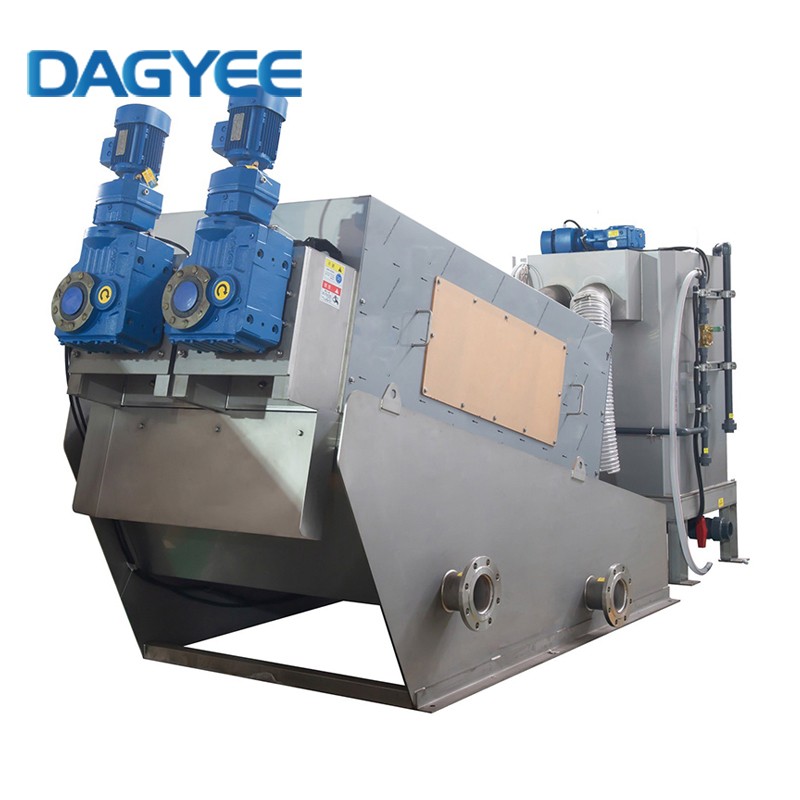
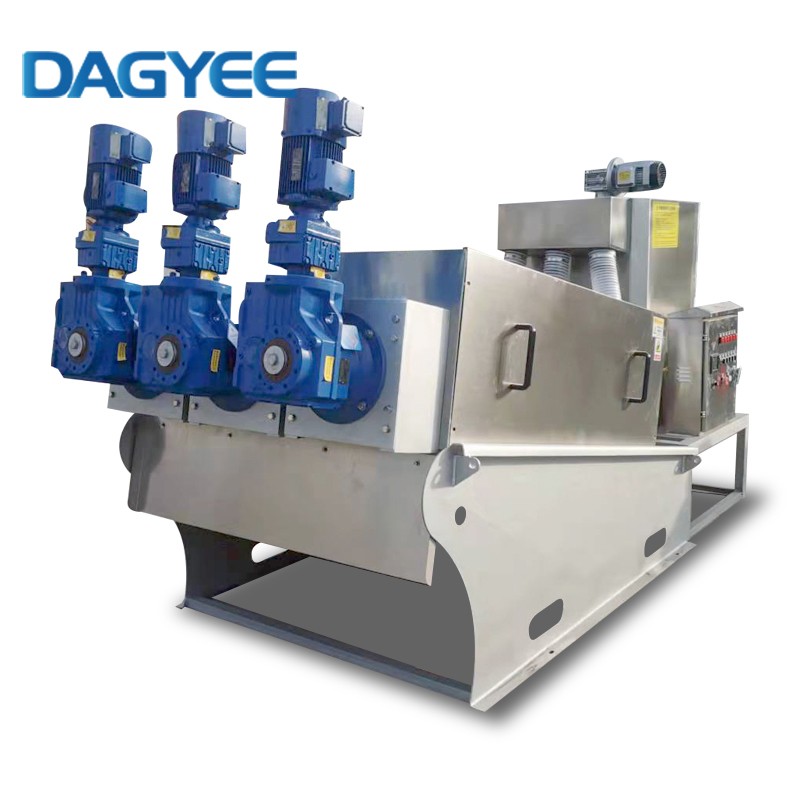
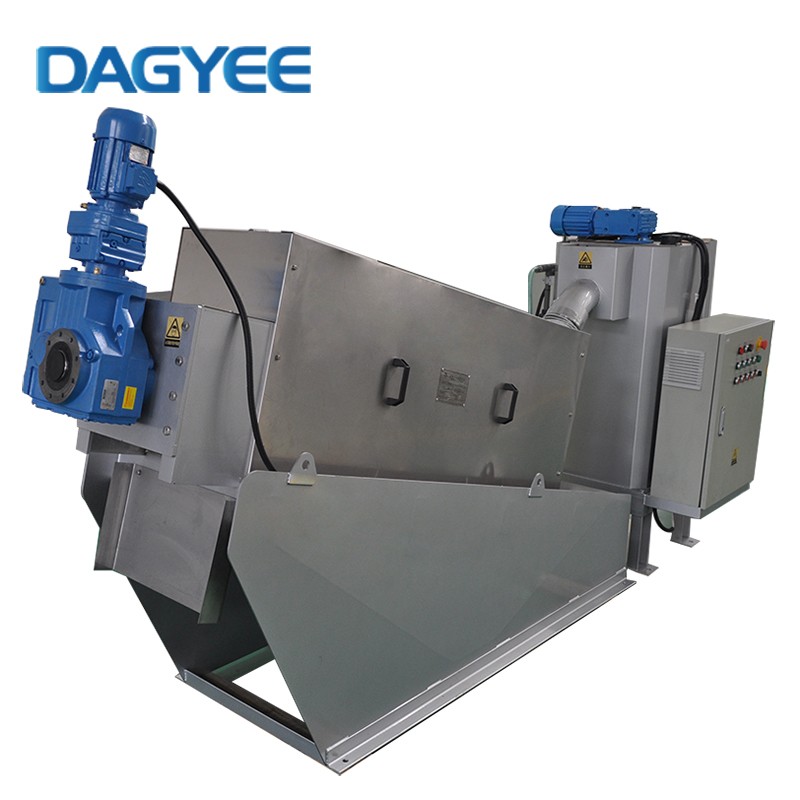
I. Sludge dehydrator introduction
Screw press sludge dewatering machine is an efficient and reliable solution to sludge water management and wastewater treatment. It utilizes a screw mechanism to transport and compress sludge, separating the water from the solid materials. The dewatered sludge cake is with reduced moisture content and volume, making it easier to handle and dispose of.
It adopts the screw extrusion principle. The rotation of the screw shaft produces a great internal pressure under the blocking action of the backpressure plate while pushing the sludge transportation so that the volume is continuously reduced, and the purpose of dewatering is finally achieved.
Discover the most efficient sludge dewatering machine designed to separate solid and liquid components of sludge. Reduce disposal costs, …
II. Sludge dehydrator description
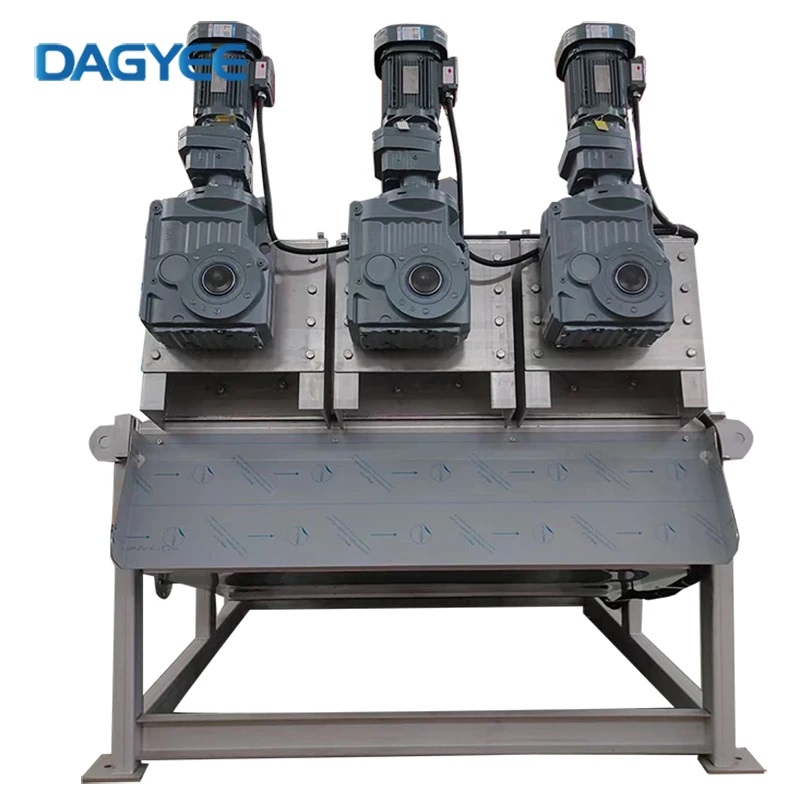
Sludge produced in municipal and industrial wastewater treatment plants requires dewatering prior to further treatment or utilisation. In view of increasing sludge disposal costs it has become necessary to concentrate the sludge to a high solids content. The main purpose of sludge dewatering equipment is to reduce the water content of sludge and reduce the volume of sludge, thus facilitating the subsequent treatment or disposal of sludge.
Sludge dewatering equipment is not intended to treat the sludge or liquid but; it only separates the liquid components & solid components so it will get easier & cost-effective to handle the separate phases of the disposal. Once the Final sludge has been dewatered, then the liquid is treated in ETP/STP & solid sludge is disposed.
Sludge is a semi-solid slurry that is produced from various industrial and municipal water treatment processes. Dewatering sludge with sludge dewatering equipment can significantly reduce its weight and volume prior to disposal. Sludge dewatering separates sludge into liquids and solids, minimizing the volume of waste and making it easier and more cost effective for final disposal.
DAGYEE offers for this purpose commonly known screw presses systems for continuous sludge dewatering.
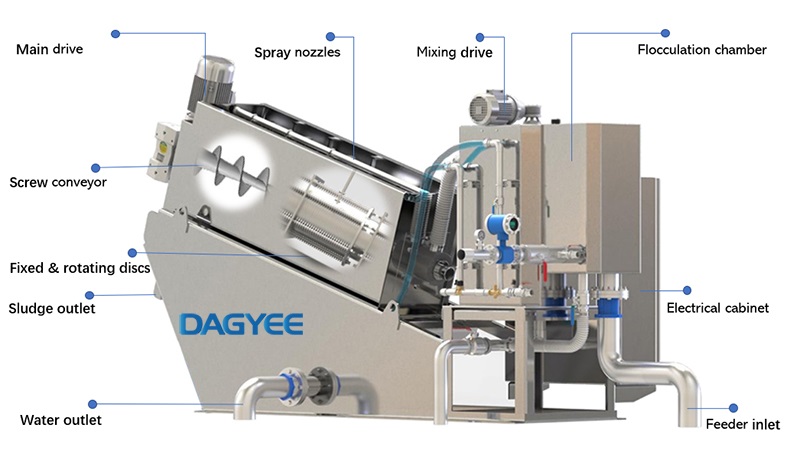
III. Sludge dehydrator process
Sludge dewatering is a process that separates water from sludge to reduce its volume and weight. This is a crucial step in wastewater treatment, as it reduces the cost of transportation, disposal, and further treatment. The dewatered sludge—often referred to as “cake”—is easier to handle, store, and dispose of, or can even be repurposed for use as compost, fuel, or in land application.
A screw press (SP) provides sludge dewatering by conveying the sludge along the inside of a permeable cylinder. It is based on a slowly-rotating (~5 RPM) Archimedean screw within a cylindrical screen (otherwise termed drum filter/screen or basket). It is normally inclined by ~20° to the horizontal to assist with the draining of water into the sump. The screen generally has an aperture rating below 0.5 mm and is based on wedge-wire or occasionally perforated metal.
The screens are less susceptible to clogging than the filter media used for other thickening and dewatering processes. Consequently, spray-cleaning is applied only intermittently for around 2−4% of the operating time.
As with all thickening and dewatering processes, the product solids (or cake) content is dependent on the feedwater sludge quality. The cake solids content has been shown to be inversely proportional to the volatile solids (VS) of the feed sludge.
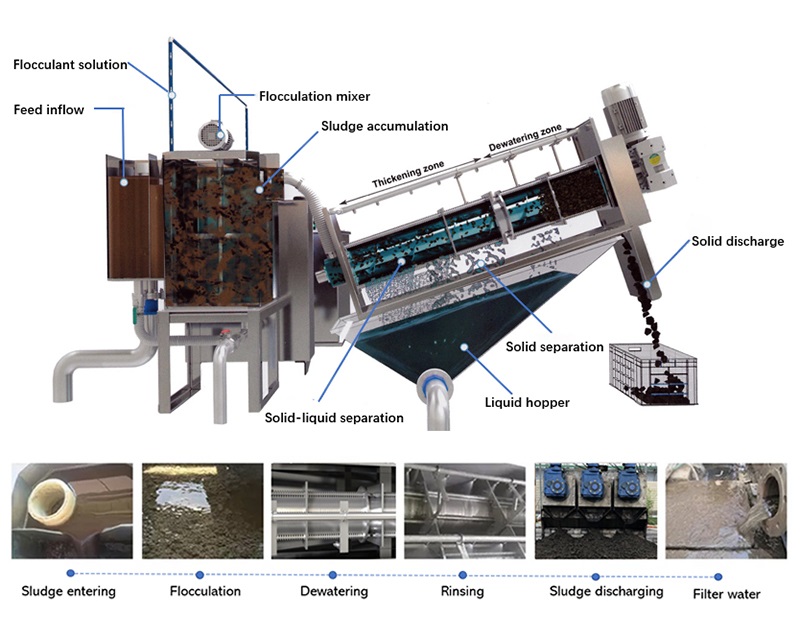
IV. Sludge dehydrator overall composition
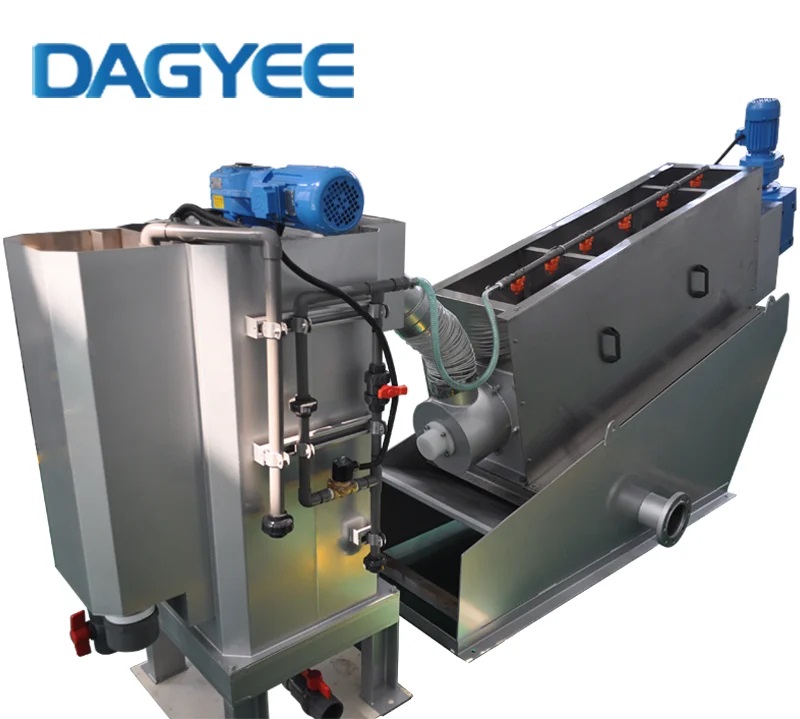
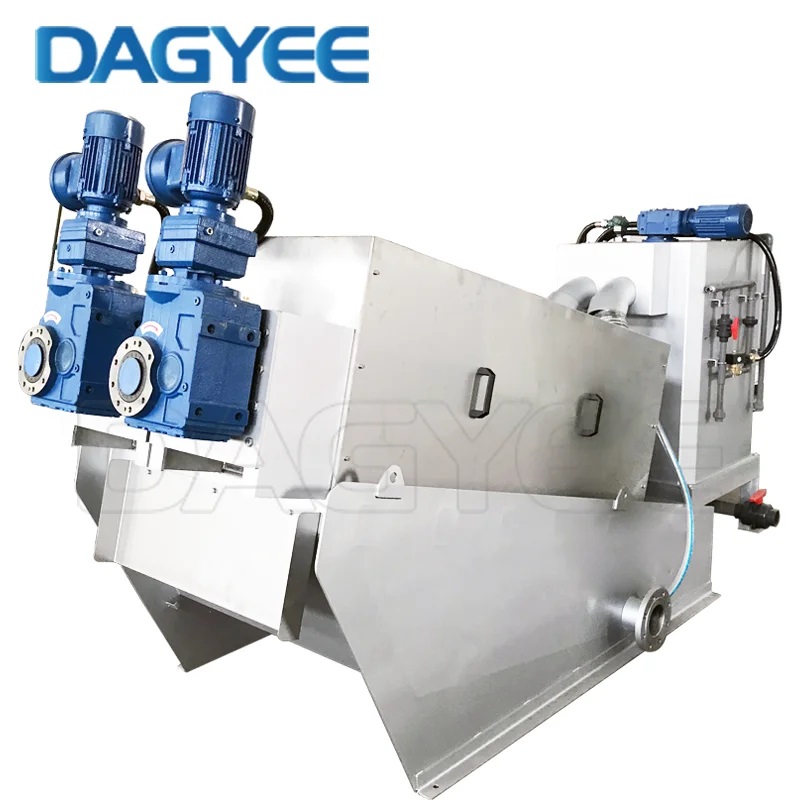
The dehydrator is mainly composed of sludge premix module, concentration and dewatering module and electric control system.
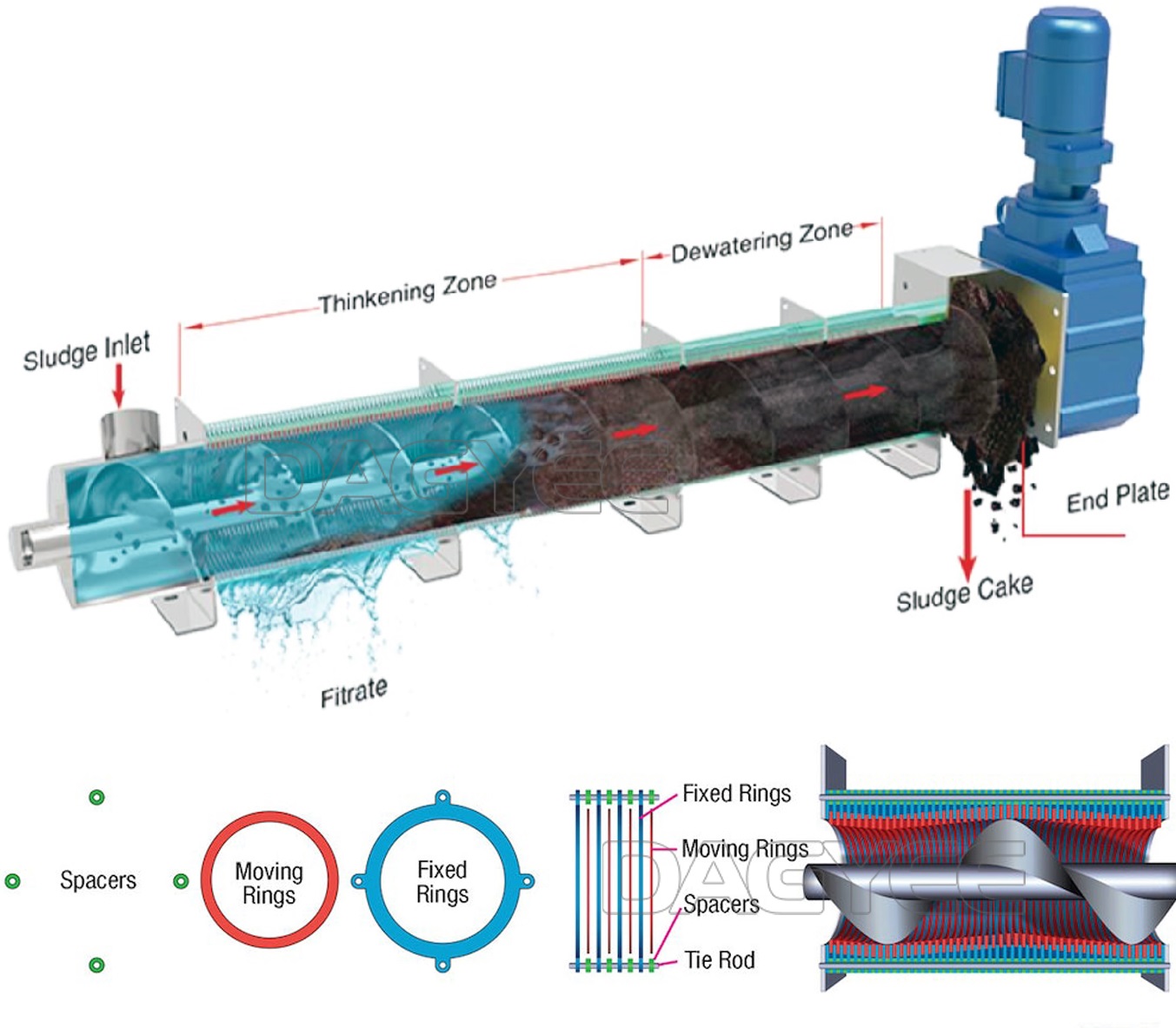
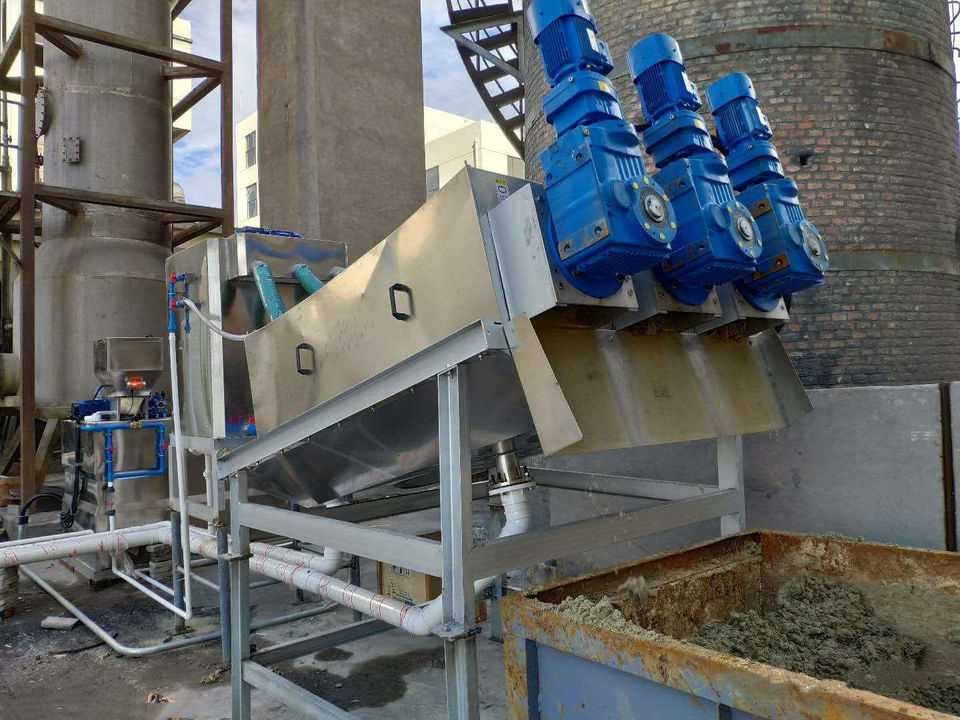
The main body of the screw press dehydrator is a filter device which is superimposed by a plurality of fixed rings and floating rings, and the screw shaft runs through it. The anterior segment is concentrated and the posterior segment is dehydrated. Sludge concentration and dewatering are done in one cylinder.
The screw press, with conical screw shaft and cylindrical screen, consists of three treatment zones: an inlet and drive zone, a three-part thickening and dewatering zone and a press zone with a pneumatic counterpressure cone. Cost-effective sludge dewatering with independent sludge treatment.
In the first part of the thickening and dewatering zone, the supernatant is quickly removed by a feed pump through a large free filter surface at low primary pressure. A pressure probe in the feed zone controls the primary pressure, thus ensuring consistent filtrate quality.
In the second part of the screen, the volume of material between the screw threads is reduced by means of a conical screw and the sludge is pressed against the inner surface of the screen, thus dewatering the sludge and decreasing the cake thickness. The screen aperture in this screen section is much smaller.
In the third part of the screen, the remaining water is pressed out of the sludge with minimum cake thickness by a pneumatic counterpressure cone at the press-out. The dewatered sludge is pushed by a screw conveyor over the pressure cone into the discharge chamber. The residence time of the sludge in the screw press as well as the filtering time can be adjusted by adjusting the speed of the screw shaft to meet individual requirements.
The initial section of dewatering drum is the thickening Zone, where the solid-liquid separating process takes place and where the filtrate will also be discharged. The pitch of the screw and the gap between the rings decrease at the end of dewatering drum, hence increasing its internal pressure, end Plate further increases the pressure, so as to discharge dry sludge cake.
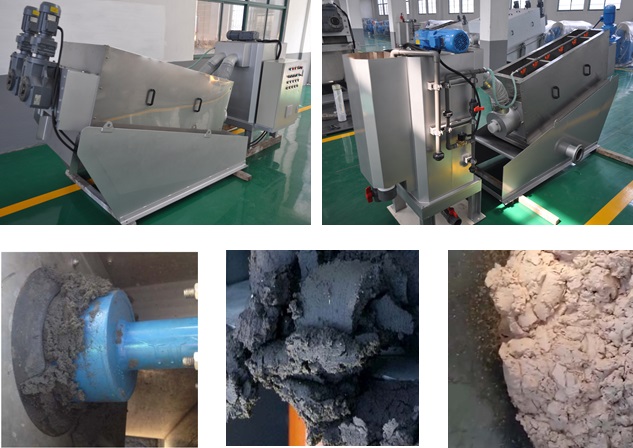
V. Sludge dehydrator complete practical operation steps
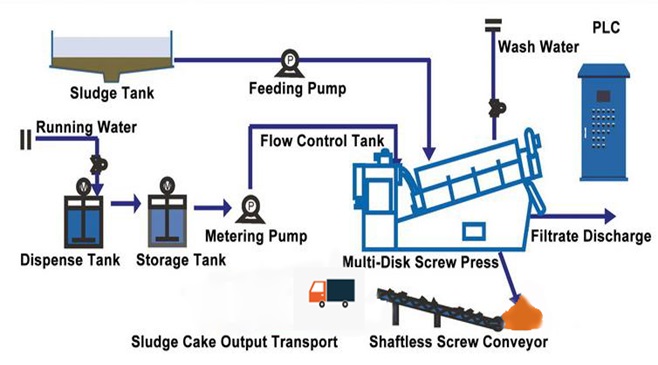
The operation of a Multi-disc Screw Press follows these basic steps:
Sludge Conditioning
Polymer is mixed with the incoming sludge to agglomerate the solid particles, forming larger flocs. This increases filtration efficiency.
Sludge Feeding
The conditioned sludge is fed into the dewatering drum.
Thickening and Dewatering
The drum consists of a screw shaft that rotates slowly. Surrounding this screw are alternating fixed and moving rings. As the screw rotates, it transports the sludge toward the outlet. During this movement: Water is drained through the narrow gaps between the discs. Pressure increases as the pitch of the screw tightens and the volume decreases, squeezing more water out of the sludge.
Cake Discharge
The dewatered sludge (now a semi-solid cake) is pushed out from the end of the screw shaft for disposal or reuse.
Sludge is first flow into the Control Tank and then flows down into the Flocculation Tank, Where polymer coagulant is added. From there, the flocculated sludge overflows into the dewatering drum where it is filtered and compressed. The entire operation sequence, including sludge feed control, polymer makeup, dosing and sludge cake discharge are controlled by the built-in timer and sensors of the PLC.
The sludge is delivered to the metering tank through the sludge pump, and then the sludge flows into the flocculation mixing tank. The excess sludge flows back to the sludge tank from the overflow pipe. Inject polymer flocculants into the flocculation mixing tank, alum floc formed after stirring, and then enters into a dewatering section of a screw press after gravity concentration (pre-treatment) section. Flocculation and dewatering are carried out in sequence, so that we have a three-stage separation process: flocculation, dewatering and concentrate recovery.
The sludge enters the dewatering machine and the sludge moves towards the sludge cake outlet under pressure from the helical screw blades. Since the pitch becomes narrower towards the outlet of the sludge cake, the sludge bears heavier pressure and begins to dewater. Water comes out from the space between fixed and moving rings while dry solids exits from the outlet.
In the actual working process, the sludge is pumped to the metering tank by an external conveying pump. The sludge after distribution further flows into the flocculation tank, reacts with the flocculant fully under the stirring of the agitator to produce stable alum flocs, and then enters the dewatering screw through the upper part of the flocculation tank. In the dehydrated body, alum flowers concentrate in the concentrated section by gravity and advance to the dehydrated section at the same time. In the process of propulsion, with the filter clearance and pitch gradually reduced, and the back pressure plate blocking effect. During the spiral rotation, the floating ring and the fixed ring will form a dislocation movement, and the water will be discharged from the gap between the floating ring and the fixed ring. It replaces the traditional filter cloth filtering method with a unique and subtle filter pattern.
VI. Sludge dehydrator model
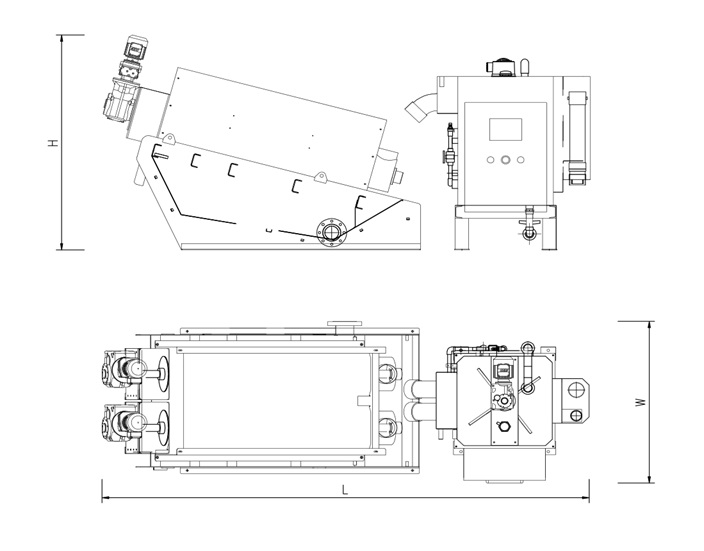
| Model | DS Capacity (kg/h) Min | DS Capacity (kg/h) Max | 2g/L | 5g/L | 2g/L (m³/h) | 5g/L (m³/h) | 10g/L | 20g/L | 25g/L | 50g/L | Spiral Diameter | Discharge Distance |
|---|---|---|---|---|---|---|---|---|---|---|---|---|
| DL101 | 3 | 5 | 1.5 | 0.6 | 1.5 | 0.6 | 0.5 | 0.25 | 0.2 | 0.1 | Φ100×1 | 215 |
| DL131 | 6 | 10 | 3 | 1.2 | 3 | 1.2 | 1 | 0.8 | 0.4 | 0.2 | Φ130×1 | 260 |
| DL132 | 12 | 20 | 6 | 2.4 | 6 | 2.4 | 2 | 1 | 0.8 | 0.4 | Φ130×2 | 250 |
| DL202 | 18 | 30 | 9 | 3.6 | 9 | 3.6 | 3 | 1.5 | 1.2 | 0.6 | Φ200×2 | 350 |
| DL301 | 30 | 50 | 15 | 6 | 15 | 6 | 5 | 2.5 | 2 | 1 | Φ310×1 | 495 |
| DL302 | 60 | 100 | 30 | 12 | 30 | 12 | 10 | 5 | 4 | 2 | Φ310×2 | 495 |
| DL303 | 90 | 150 | 45 | 18 | 45 | 18 | 15 | 7.5 | 6 | 3 | Φ310×2 | 495 |
| DL352 | 120 | 200 | 60 | 24 | 60 | 24 | 20 | 10 | 8 | 4 | Φ350×2 | 580 |
| DL353 | 180 | 300 | 60 | 36 | 60 | 36 | 30 | 15 | 12 | 6 | Φ350×3 | 580 |
| DL402 | 120 | 200 | 60 | 24 | 60 | 24 | 20 | 10 | 8 | 4 | Φ410×2 | 585 |
| DL403 | 180 | 300 | 60 | 36 | 60 | 36 | 30 | 15 | 12 | 6 | Φ410×3 | 585 |
VII.Sludge dehydrator advantages
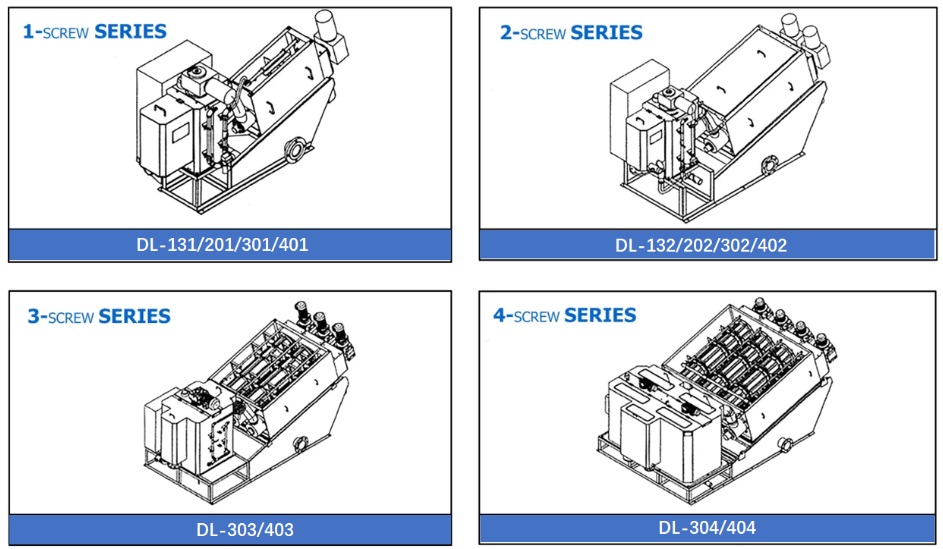
Core structural design advantages
1. Compact Design
The machine is designed with a compact structure, occupying small space so that it can easily work with existing wastewater treatment systems. Besides, the modular design makes it easy to install and maintain.
2. Continuous Operation
The machine operates continuously, allowing for a consistent and uninterrupted dewatering process for 24 hours. It can be automatic, with low maintenance and monitoring needed.
Energy consumption, water usage, and practical advantages
1. Low Energy Consumption
The slow rotation speed of the screw press, typically ranging from 1 to 4 RPM. It requires lower energy consumption compared to high-speed centrifuges or belt filter presses, which helps to reduce operation costs.
2. Low Power Consumption
The screw press operates at a low rotational speed (typically 2–5 RPM), resulting in significantly lower power usage compared to centrifuges or belt presses. This leads to reduced operational costs.
3. Minimal Water Usage
Unlike belt presses which require a constant flow of wash water to clean belts, it uses self-cleaning rings that reduce water usage dramatically.
4. Continuous and Automated Operation
Designed for 24/7 operation, IT has minimal operator requirements. Most models include automatic polymer dosing, sludge feeding, and cake discharge systems.
5. Compact and Space-saving Design
Its compact footprint makes it ideal for plants with limited space. The enclosed design also minimizes odor and improves plant hygiene.
6. Low Noise and Vibration
With slow operation and fewer moving parts, it generates minimal noise, creating a safer and more pleasant work environment.
7. High Dewatering Efficiency
Depending on the type of sludge and polymer used, it can achieve solid contents in the range of 18% to 30%, making it competitive with traditional systems.
VIII. Sludge dehydrator key features
Power-saving operation
The screws inside the cylinder of the Sludge Dewatering Machine rotate at a very low speed – approximately 2 to 4 rpm – and consume very little energy. It reduces the power consumption in kWh per ton of dry solids by up to 90% in comparison with a centrifugal dewatering machine.
Water-saving design
The Sludge Dewatering Machine uses the moving rings to create a unique self-cleaning mechanism to keep the filter element clean and “open”, whereas competing technologies use large amounts of (pressurized) rinsing water for this purpose. That explains the major savings in rinsing water consumption that it offers.
Compared to a belt press and a centrifugal dewatering machine with the same throughput, a VOLUTE™ uses 90 to 95% less rinsing water.
Significantly extended lifespan of consumables reduces OPEX
The moving rings are driven by an external driveshaft to prevent contact with the screws, creating a friction-less design. This drastically extends the lifetime of consumable parts, resulting in an even better OPEX than our classic models already have.
No pre-thickening required
The machine’s design integrates both thickening and dewatering of the sludge, which allows processing of low-concentration sludges – having a TS of 0.5% or more – in a single machine without any pre-thickening system. This eliminates the costs for construction and operation of thickening and storage systems and reduces odors. On top, it reduces phosporus and nitrogen emmissions back into the waste water treatment plant, by dewatering the sludge when it’s as fresh as possible.
IX. Sludge dehydrator applications
Screw press dewatering machine is widely used in fruit and vegetable juicing, agricultural waste dewatering, distiller’s grains dewatering, crushing and dewatering of fruit waste and vegetable waste, decomposition of food waste, extrusion dewatering of domestic waste, solid-liquid separation of animal feces, dewatering of pulp, sawdust, and sludge.
The versatility of the Sludge Dewatering Machine allows it to handle a wide variety of sludge types.
It is suitable for:
Municipal Wastewater Treatment Plants
Effluent Treatment Plants (ETP)
Sewage Treatment Plants (STP)
Food & Beverage Industry
Paper & Pulp Industry
Textile & Dyeing Industry
Chemical & Pharmaceutical Plants
Tannery & Leather Processing Units
Whether dealing with oily sludge, organic sludge, or fibrous sludge, it can adapt and deliver consistent performance.

Contact us:

Name: Ashely Li
Mobile:+8613961861780
Tel:+8613961861780
Whatsapp:8613961861780
Email:info@dagyee.com
Add:Room 302, Building 11-4, Hongyi Road, Xinan Town, Xinwu District, jiangsu Province, China